
Pigments 7 Is Here: Arturia Refines Its Flagship Software Synth
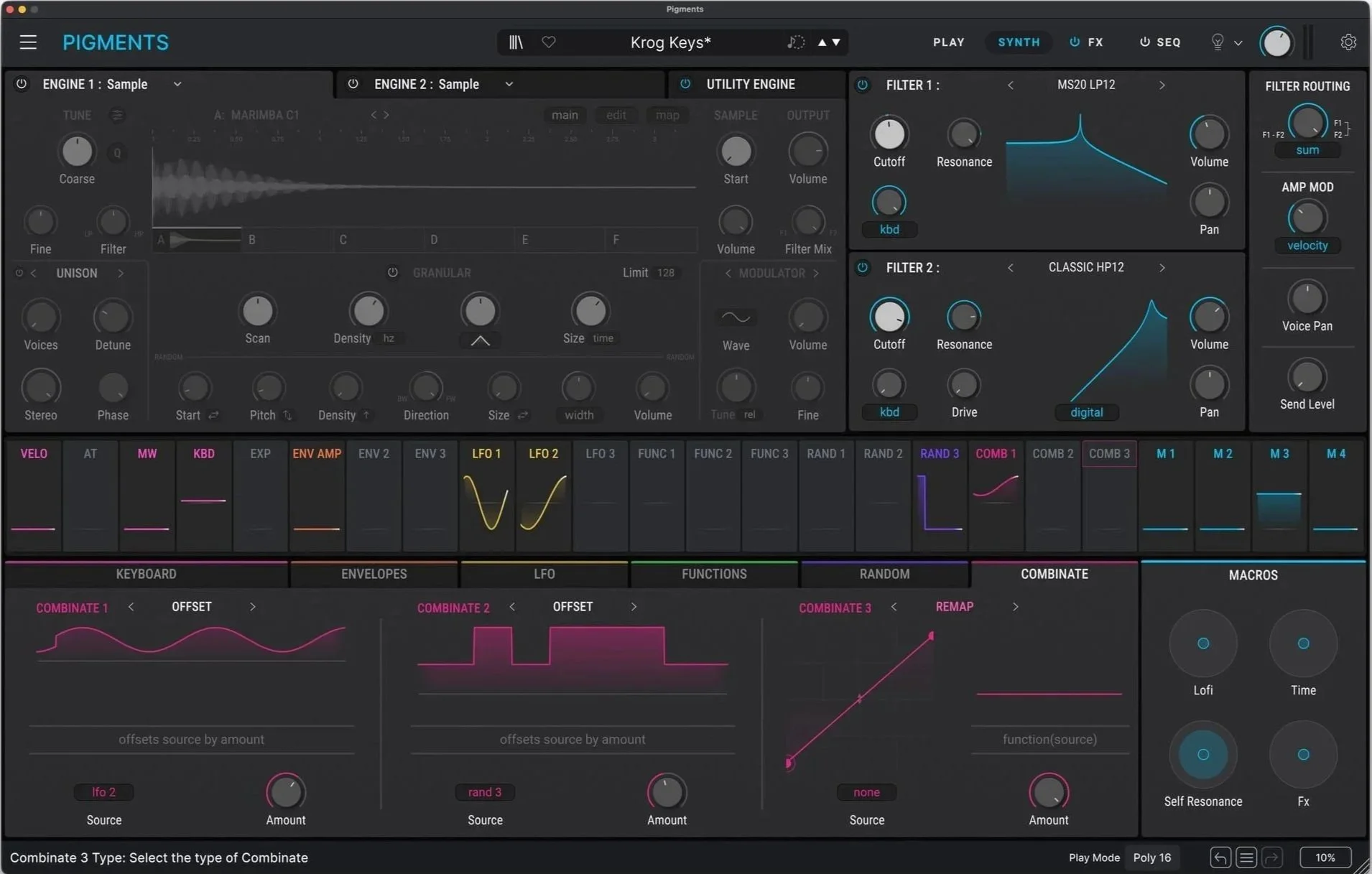
Arturia Pigments 7 arrives as a reminder of why Pigments has become one of the defining software synths of the last few years. From the start, Pigments stood out not just for what it could do — hybrid engines, deep modulation, polished presets — but for how clearly it communicated those ideas to the user. It managed to feel powerful without being hostile, experimental without being cryptic, and that balance is a big reason it’s become a staple across electronic music, film scoring, and modern pop production. With Pigments 7, Arturia isn’t trying to reinvent the instrument or bolt on a flashy new synthesis engine for the sake of headlines. Instead, this update focuses on character, playability, and clarity. New filters and effects push the sound further into expressive, sometimes aggressive territory, while UI and workflow changes make it easier to understand what’s happening under the hood. It’s a version that feels less about expanding the checklist and more about refining Pigments into a more intentional, musical instrument.
What’s New in Pigments 7
At a high level, Pigments 7 is a refinement-focused update. There’s no brand-new synthesis engine this time, but the changes touch nearly every part of the instrument: sound shaping, modulation feel, workflow, and how presets communicate their intent. The headline additions are new character-driven filters, a new distortion effect, a redesigned Play Mode, and a set of under-the-hood improvements that make Pigments feel tighter and more responsive in everyday use.
A big part of this update is about making sound design decisions more audible and visible. Pigments has always been deep, but Pigments 7 puts more emphasis on tone and motion rather than raw complexity. Whether you’re browsing presets, shaping a bass, or pushing modulation into extremes, the update consistently nudges the synth toward clearer feedback and stronger sonic identity.
Beyond features, there’s also a meaningful content refresh. Pigments 7 ships with new factory presets, additional expansion sounds, new wavetables, and fresh samples and noise sources, giving existing users immediate reasons to explore the update. Taken together, the changes feel intentional: fewer headline-grabbing additions, more focus on how Pigments actually behaves as an instrument when you sit down to play it.
Sound & Character – Filters, distortion, and tonal identity
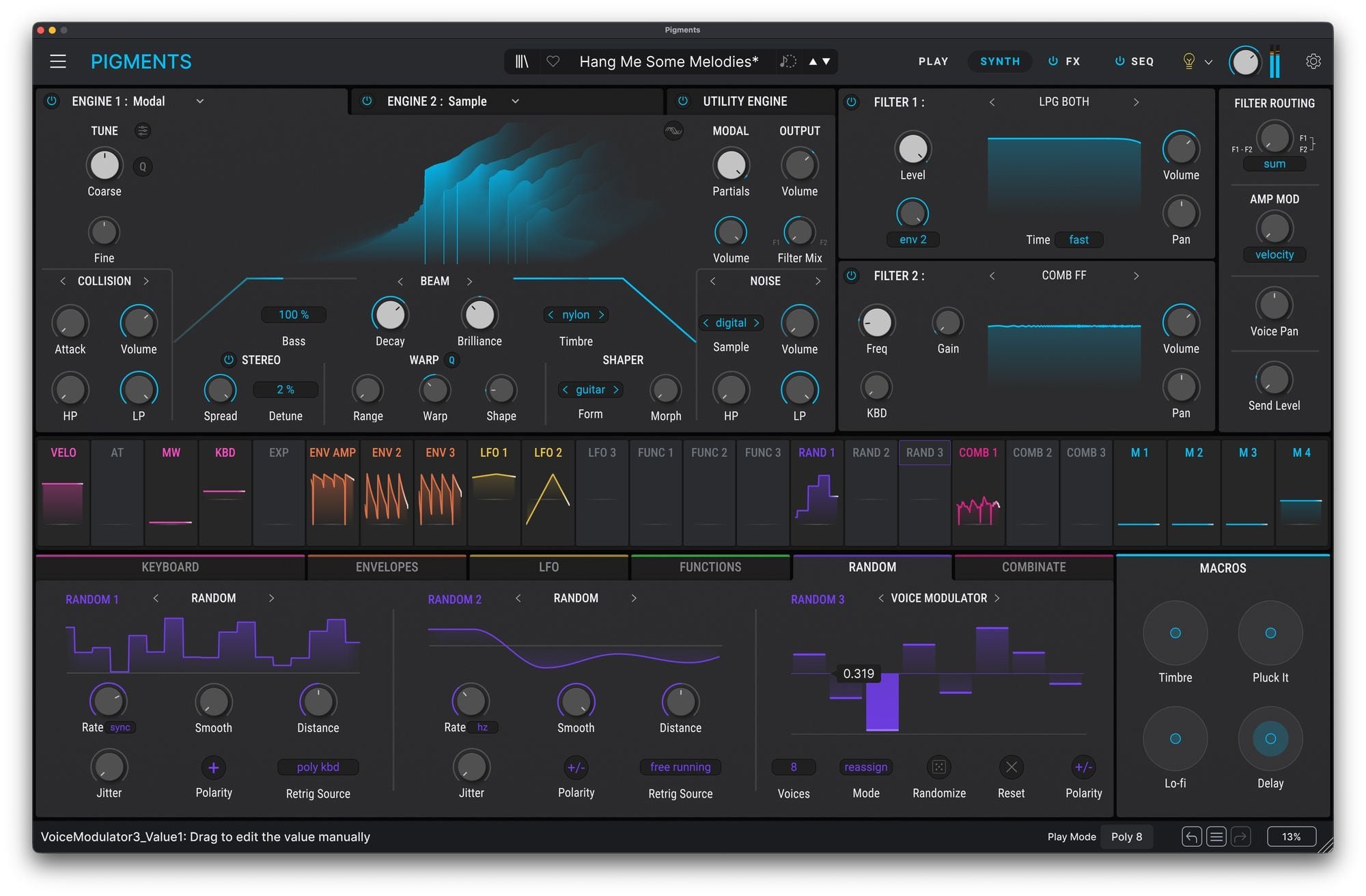
One of the clearest shifts in Pigments 7 is its emphasis on tone-shaping as a creative choice, not a corrective step. The new filter models — Rage, Ripple, and Reverb — aren’t subtle variations on familiar designs; they’re voiced to leave a clear imprint on the sound. Rage brings controlled aggression and density, Ripple introduces phase-driven motion that feels alive even with minimal modulation, and Reverb blurs the line between filtering and spatial coloration. These filters encourage you to lean into character early, rather than polishing things later with external effects.
That focus continues with the new Corroder distortion, which adds a different flavor than Pigments’ existing drive options. Instead of clean saturation or obvious clipping, Corroder excels at texture and erosion, making it particularly useful for basses, industrial-leaning leads, and sound design where grit needs to feel intentional. Combined with expanded FM routing on filters, Pigments 7 makes it easier to create harmonically complex sounds that evolve under modulation without collapsing into noise.
What’s important here is how integrated all of this feels. The new filters and distortion don’t sit off to the side as optional extras — they’re woven into Pigments’ core signal flow, encouraging experimentation at the synthesis stage. For users who already loved Pigments for pads and cinematic textures, this update adds weight and edge. For producers focused on modern club sounds, it gives Pigments a firmer footing in aggressive, forward-driven material.
Play Mode & Workflow – Making complexity feel playable
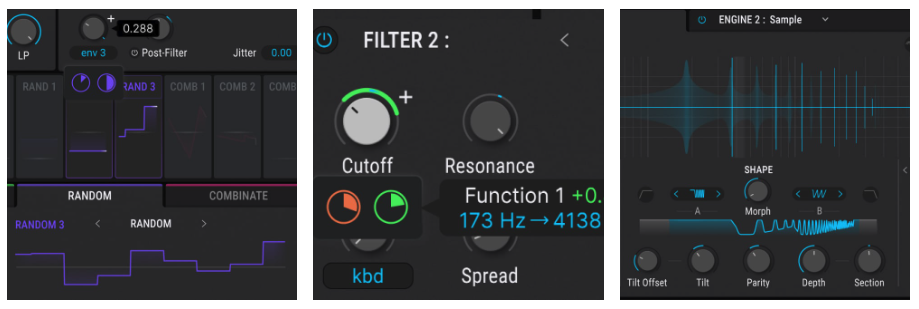
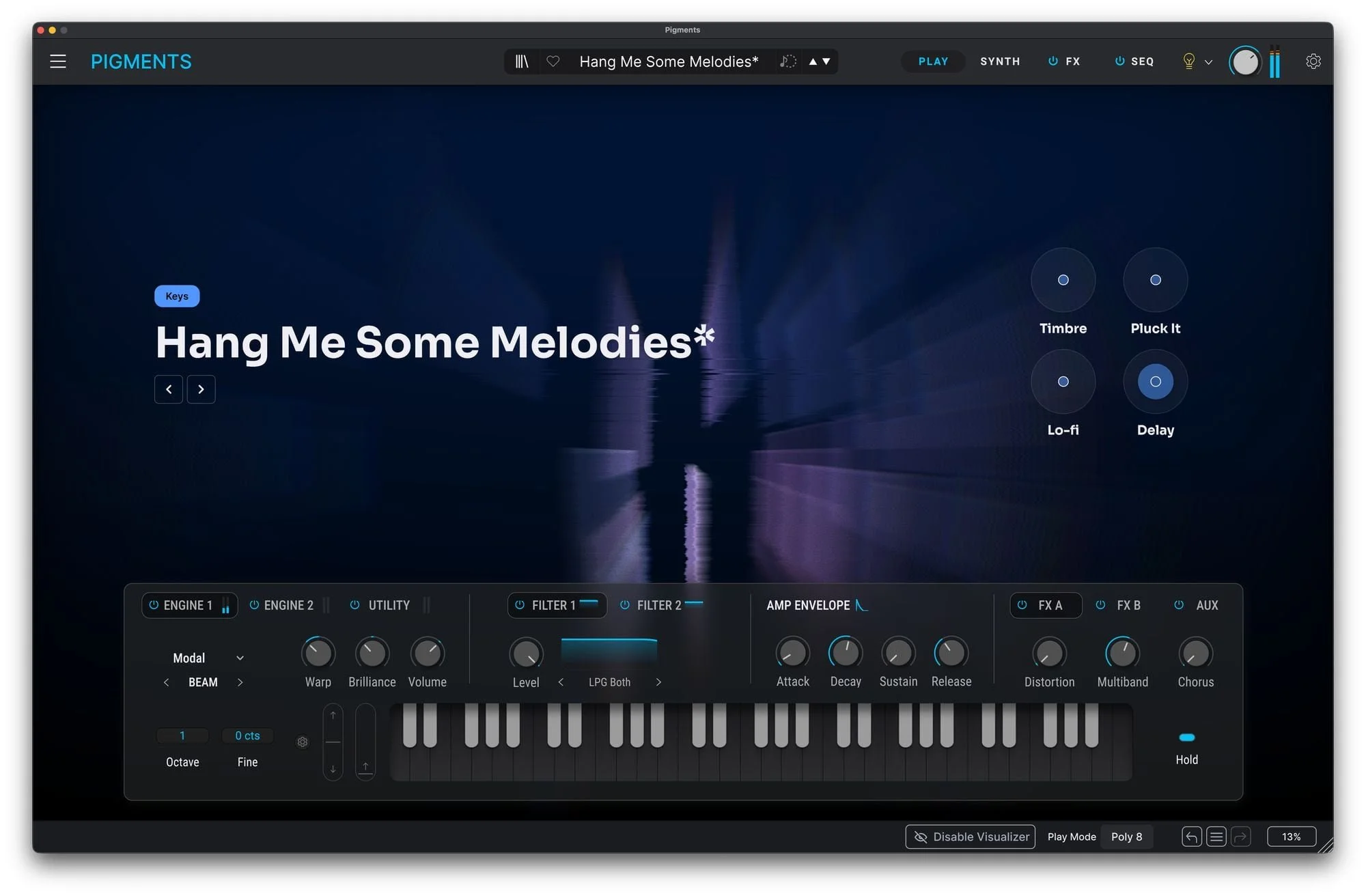
Pigments 7 puts noticeable attention into how the synth feels to use, especially when you’re not in full sound-design mode. The redesigned Play Mode is cleaner, more compact, and more visually informative, surfacing performance-relevant controls without pulling you into deeper pages. Instead of feeling like a stripped-down view, Play Mode now feels like a deliberate performance layer — something you can stay in while writing, jamming, or auditioning ideas quickly.
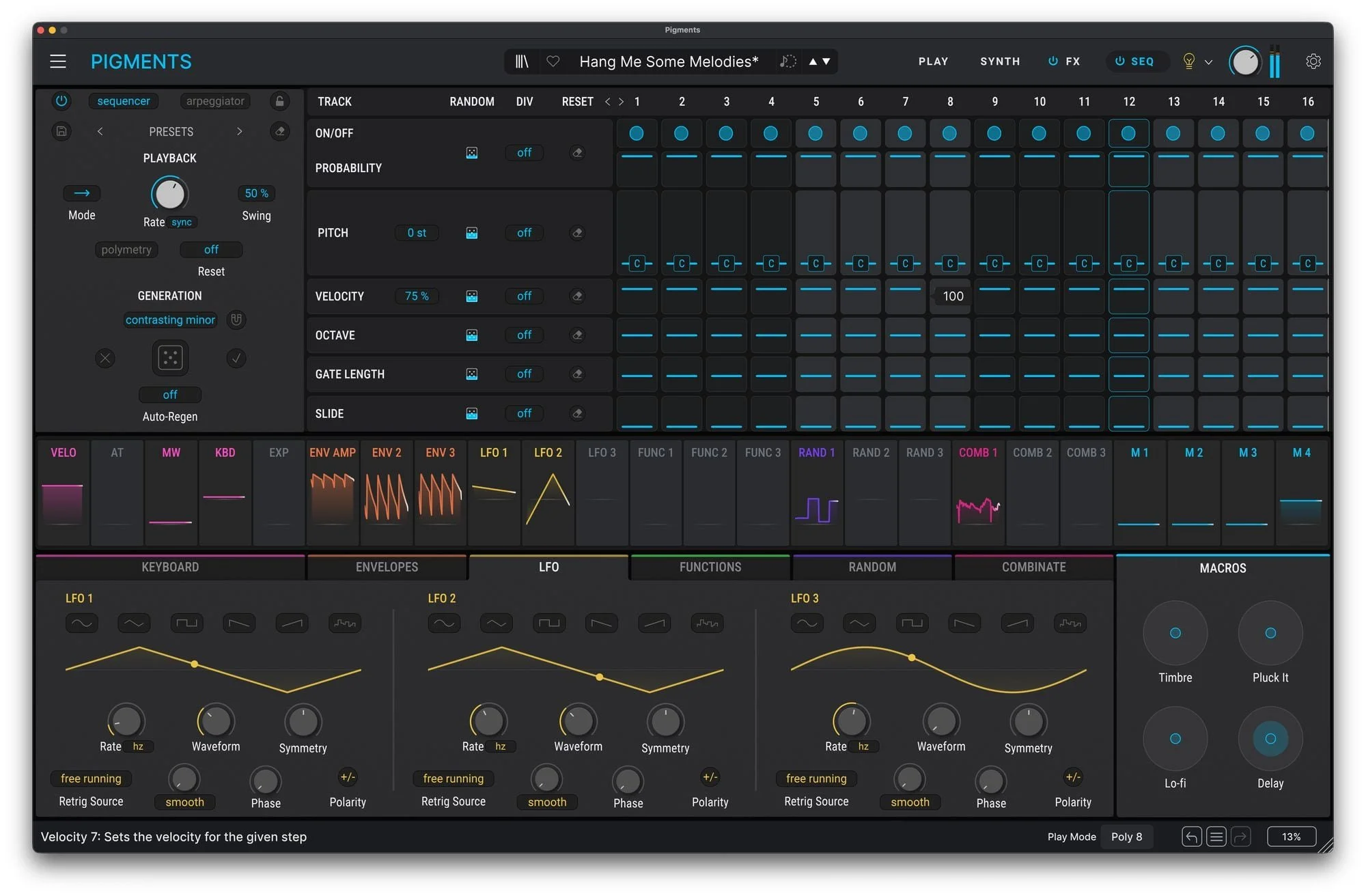
A key improvement is how Pigments 7 uses visual feedback to explain sound behavior. Animated elements respond to modulation, envelopes, and movement in a way that makes it easier to understand what’s driving a sound, even before you touch a knob. This pairs well with the new reactive in-app tutorials, which guide users through presets by showing how tone, timbre, and modulation interact. It’s especially helpful when opening complex patches, where the synth now communicates intent instead of leaving you to reverse-engineer it.
There are also quieter upgrades that experienced users will feel immediately. Snappier amplitude envelopes, smoother transient handling, and general CPU optimizations make Pigments feel more responsive, particularly in rhythm-focused patches and layered sounds. These aren’t flashy additions, but they reinforce Pigments’ reputation as a synth that balances depth with immediacy — one that stays out of the way when inspiration hits.
Presets & Content – A strong update even if you don’t design sounds
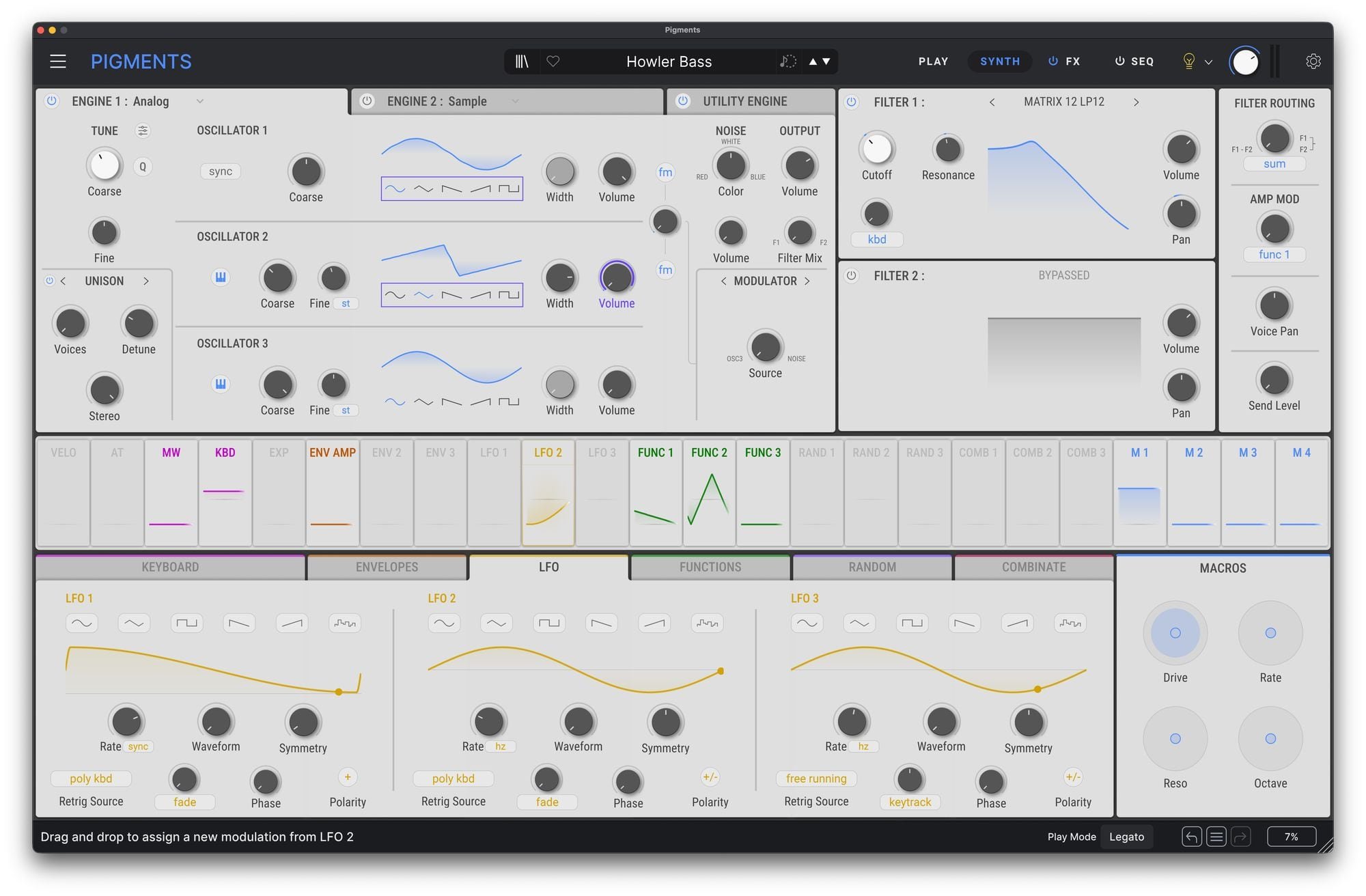
Pigments 7 arrives with a substantial content refresh that makes the update immediately useful, even if you mostly live in preset browser mode. The new version adds 150 new factory presets, alongside 450 expansion presets, covering modern electronic styles, cinematic textures, and more experimental sound design. These aren’t filler patches — they’re clearly built to showcase the new filters, distortion, and modulation behavior introduced in this update.
Beyond presets, Pigments 7 expands its raw materials with 50 new wavetables, plus new samples and noise sources, giving sound designers more starting points without overloading the interface. Paired with the improved Play Mode and clearer visual feedback, the preset experience feels more intentional: it’s easier to understand what a sound is meant to do and how to adapt it quickly. For producers who rely on inspiration over deep programming, this alone makes Pigments 7 feel like a meaningful step forward.
Alternatives to Pigments 7 – Similar power, different priorities
In the landscape of flagship software synths, Pigments 7 sits in a very specific sweet spot, but there are strong alternatives depending on what you value most. Xfer Serum 2 remains a favorite for producers who want deep, precise wavetable control and a more engineering-forward approach to sound design, especially for bass-heavy electronic styles. u-he Diva, on the other hand, focuses almost entirely on analog realism, trading hybrid flexibility for unmistakable vintage tone and circuit-level behavior.
Looking at broader hybrid instruments, Native Instruments Massive X offers enormous depth and sonic power, but its workflow can feel opaque and demanding compared to Pigments’ visual clarity. Spectrasonics Omnisphere stands out for its massive sound library and cinematic scope, though it’s heavier, more preset-driven, and less immediate for hands-on modulation. Against these, Pigments 7 continues to stand out for its balance: modern sound design depth, expressive character, and an interface that stays readable even as patches become complex.
Pros & Cons
Pros
Highly flexible hybrid architecture that covers wavetable, virtual analog, granular, sampling, and more in a single instrument
New character-driven filters and distortion add weight, motion, and aggression without sacrificing clarity
Improved Play Mode and visual feedback make complex patches easier to understand and tweak quickly
Free update for existing users, with meaningful sound, workflow, and content additions
Cons
No new synthesis engine, which may disappoint users expecting a headline expansion
Depth and visual density can still feel overwhelming for producers who prefer minimal interfaces
Some character-heavy filters and effects can increase CPU usage in complex patches
Not focused on strict vintage emulation compared to dedicated analog-modeling synths
Is Pigments 7 for You?
Pigments 7 makes the most sense for producers who want one modern synth that can comfortably live at the center of their setup. If you work across electronic genres, sound design, scoring, or hybrid production styles, Pigments continues to offer an unusually broad range of synthesis approaches without feeling fragmented. The new filters, distortion, and workflow refinements push the instrument toward stronger sonic identity and faster musical decisions, especially when shaping sounds in context rather than in isolation.
That said, Pigments 7 isn’t trying to be everything for everyone. If your priorities lean heavily toward strict analog realism, ultra-minimal interfaces, or a single synthesis method taken to its absolute extreme, other tools may suit you better. For everyone else, Pigments 7 reinforces why it remains one of the most future-proof software synths available: deep without being opaque, expressive without being chaotic, and continually refined in ways that reward both exploration and efficiency.
Disclosure: This site contains affiliate links. If you purchase through these links, I may earn a commission at no extra cost to you.