
Best Mini Synths in 2026: 7 Small Synthesizers with a Giant Sound
A great synthesizer doesn't necessarily need to dominate your studio. Whether you're producing music in a bedroom, or simply running out of room for another full-sized keyboard, a mini synth can be one of the easiest ways to expand your setup without turning your desk into a gear museum. These days, small synthesizers pack serious sound engines, sequencing tools and hands-on controls into surprisingly compact designs. Some are barely larger than a paperback book, while others offer a proper keyboard but take up significantly less space than a traditional synthesizer. For this list, we're focusing specifically on small synths for limited studio space. If your main priority is battery power and making music away from your studio, check out our guide to the best portable synths instead. This list is for producers whose biggest limitation is desk space, not luggage space.
1. Behringer JT-4000 MICRO
Best ultra-small synth
The Behringer JT-4000 MICRO is one of the smallest synthesizers you can put on a desk while still getting a surprisingly complete synth engine. Inspired by the classic Roland JP-8000 sound, the tiny hybrid synthesizer includes four voices, two analog-modeling oscillators per voice, an analog filter and the famous Supersaw-style sound that helped define late-'90s and early-2000s electronic music.
Its biggest advantage is obvious: the footprint is almost absurdly small.
This is the kind of tiny synthesizer you can place beside a MIDI controller, audio interface or drum machine without having to reorganize your entire workspace. The small enclosure makes it particularly appealing as a second synth for producers who already have their main keyboard and simply want another source of leads, pads or aggressive electronic textures. Despite its size, the JT-4000 MICRO includes programmable presets, USB/MIDI connectivity, envelopes and LFOs. It is far more than a novelty.
The compromise is the interface. The capacitive keyboard and compact controls make sense considering the price and size, but this isn't the mini synth to buy if you want the feel of a traditional keyboard. Still, if your goal is to get a genuine synthesizer into the smallest possible amount of desk space, the JT-4000 MICRO is difficult to beat.
Check the latest price
2. Korg Volca Keys
Best budget analog mini synth
The Korg Volca Keys remains one of the best examples of how much synthesizer can fit into a small box. At just 193 mm wide and 115 mm deep, it takes up less desk space than a computer keyboards while offering a genuine analog synth architecture with three VCOs, a filter, LFO, envelope and built-in delay. The Volca Keys is particularly interesting because it doesn't just feel like a miniature version of a bigger product. Its limitations are part of its character.
The three oscillators can be used in different modes, allowing you to create thicker unison sounds, chord-based textures and more traditional polyphonic patches. The built-in sequencer also makes it easy to turn the synth into a standalone sketchpad sitting beside your main production setup. For producers working in electronic music, the sound can be surprisingly warm and characterful for such a small synthesizer. It works particularly well for lo-fi electronic music, techno, house, ambient and experimental productions.
The biggest limitation is that the Volca Keys is still a deliberately simple instrument. Three voices won't suit every type of playing, and the tiny touch keyboard isn't ideal for performing complicated parts. But as a small synth that can permanently live on a crowded desk, it remains one of the best values available.
Check the latest price
3. Behringer Crave
Best mini synth for patching and experimentation
The Behringer Crave is a very different kind of mini synthesizer. Instead of shrinking down a traditional keyboard synth, the Crave focuses on putting a semi-modular analog synthesizer into a compact desktop format. Its patch bay gives you access to a huge amount of flexibility relative to its size.
The synth features an analog signal path, a 3340 VCO, analog filter and VCA, along with a 32-step sequencer and arpeggiator. This makes the Crave particularly appealing if your desk is too small for a larger modular or semi-modular system. You can use it as a straightforward analog monosynth, but the patch points allow you to experiment with modulation and signal routing in ways that are difficult to achieve on many synths in this price range.
The small footprint also makes it easy to integrate with other desktop gear. Put it next to a drum machine, another semi-modular synth or an audio interface and you have the beginning of a surprisingly capable hardware setup.
Its biggest limitation is also part of its design philosophy: the Crave isn't an all-in-one keyboard instrument. If you want to sit down and immediately play chords, this isn't the right choice. But for producers who enjoy patching and want a compact analog synth that encourages experimentation, the Crave is one of the most interesting options in this category.
Check the latest price
4. Arturia MicroFreak
Best mini synth for sound design
The Arturia MicroFreak is arguably the most creatively ambitious synthesizer on this list. It isn't the smallest product here, but its footprint is still remarkably compact considering how much synthesis is packed inside. At just over 31 cm wide, it can comfortably sit beside a laptop or MIDI controller without demanding the space of a traditional keyboard synthesizer.
The MicroFreak combines a digital oscillator section with an analog state-variable filter. Its collection of oscillator modes covers everything from wavetable and virtual analog-style sounds to physical modeling, granular processing and more experimental territory. That flexibility is what makes it such a strong choice for producers who don't want their small synth to feel limiting.
You can create conventional basses and leads, but the MicroFreak really becomes interesting when you start exploring unusual textures, evolving sequences and sounds that would be difficult to create on a traditional subtractive synth. The modulation matrix is another major advantage. Despite the relatively compact layout, there is enough routing flexibility to keep experienced sound designers busy.
The one thing you'll either love or hate is the keyboard. The MicroFreak uses a flat capacitive touch keyboard rather than traditional moving keys. It can detect pressure and offers a unique playing experience, but it definitely takes some adjustment.
Still, if you only have room for one small synthesizer and want the widest possible range of sounds, the MicroFreak is one of the strongest choices available.
Check the latest price
5. Roland JU-06A
Best mini synth for classic Roland sounds
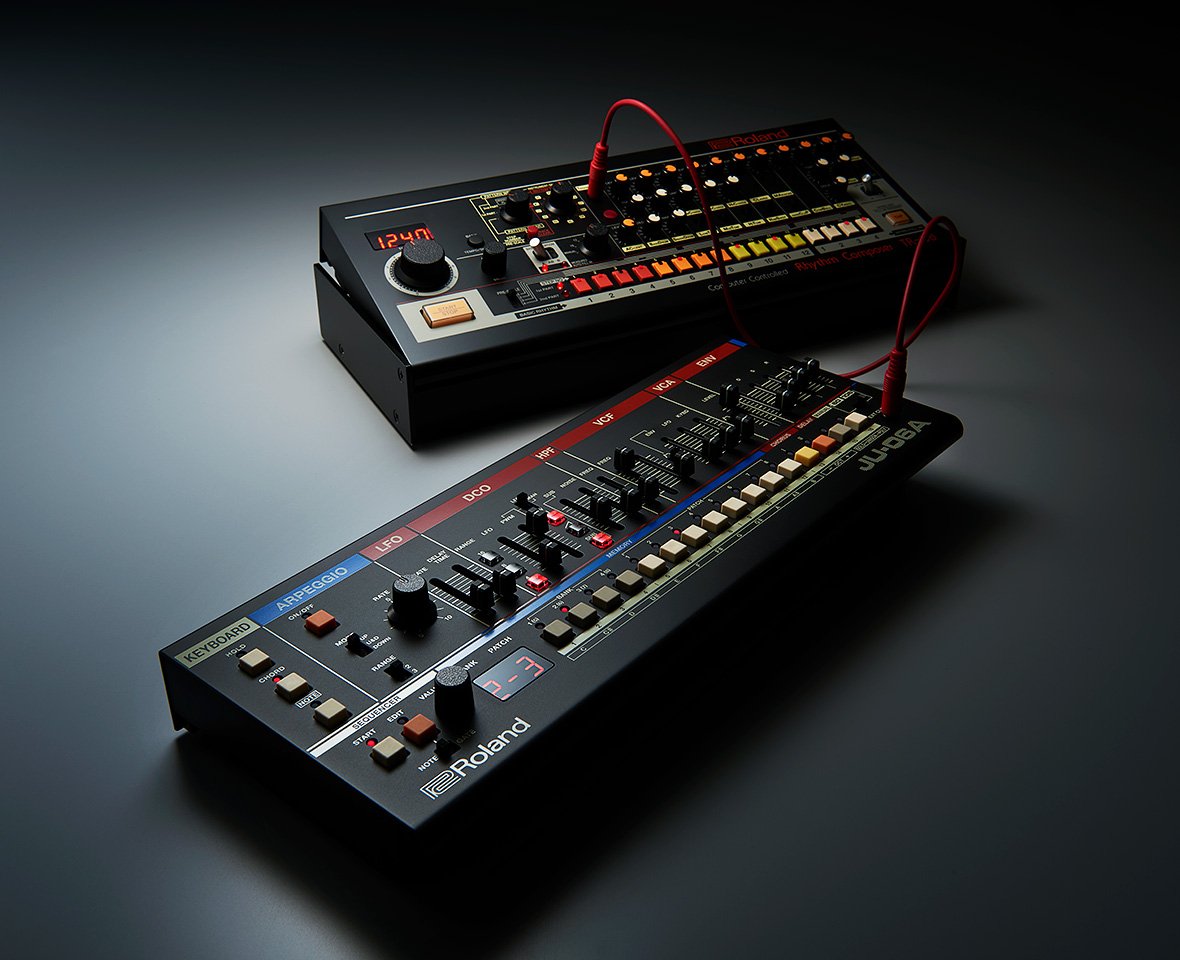
The Roland JU-06A is a small desktop synth designed around one of the most recognizable sounds in electronic music. The Roland Boutique module recreates elements of both the JUNO-60 and JUNO-106, giving you access to classic Juno-style oscillators, filters and chorus in a unit that is just 300 mm wide. That makes it an excellent option for producers who want the character of a vintage Roland synthesizer without dedicating a large section of their studio to one.
The JU-06A is particularly appealing because the compact front panel still provides plenty of hands-on control. Instead of relying heavily on menus, you get a familiar collection of sliders and switches for shaping your sound. It works beautifully for warm pads, basses, chords and the kind of slightly imperfect, chorus-heavy sounds associated with countless electronic and pop records.
The small footprint also makes it a good companion to an existing MIDI controller. You don't need another keyboard taking up space—you can simply place the JU-06A above or beside the controller you already use.
The biggest limitation is the four-voice polyphony. That's enough for plenty of classic synth parts, but players looking for large sustained chords may find it restrictive. It is also worth remembering that the JU-06A is primarily a module. If you want physical keys, you'll need to provide your own MIDI controller or purchase Roland's optional Boutique keyboard.
Check the latest price
6. Yamaha Reface CS
Best small synthesizer with a proper keyboard
The Yamaha Reface CS stretches the definition of a mini synth slightly, but for good reason. At 530 mm wide, it is larger than the desktop units above. However, its extremely shallow 175 mm depth and slim profile make it dramatically easier to fit into a small workspace than most traditional keyboard synthesizers.
This is the synth to consider if you want actual playable keys but simply don't have the room for a full-sized instrument. The Reface CS features Yamaha's virtual analog-style AN engine with five oscillator types and up to eight voices of polyphony. More importantly, it has one of the most immediate interfaces in this entire roundup.
Most of the important controls are right in front of you. There is very little menu diving, which makes it easy to move from an initial idea to a finished sound. The mini keys are also significantly more playable than the tiny touch strips and button-style keyboards found on many pocket synthesizers.
The downside is that it isn't as tiny as products like the Volca Keys or JU-06A. If every square centimeter of your desk matters, one of those options may make more sense. But if your priority is getting a genuinely playable keyboard into a compact studio, the Reface CS remains one of the best small synthesizers available.
Check the latest price
7. Roland JD-Xi
Most versatile mini keyboard synth
The Roland JD-Xi is the largest instrument on this list, but it earns its place because of how much it manages to combine into a relatively compact keyboard. At 575 mm wide, it is still dramatically smaller than many full-sized synthesizers while including 37 mini keys, an analog synth voice, Roland's SuperNATURAL digital synthesis engine, drum sounds and a built-in pattern sequencer.
In other words, this is the mini synth for someone who wants one compact instrument capable of doing several jobs. The analog section handles basses and leads, while the digital engine can cover pads, strings, synth textures and more traditional keyboard sounds. The sequencer and drum section also make it possible to sketch out complete musical ideas without immediately opening your DAW.
Roland even includes vocal effects such as a vocoder and AutoPitch functionality, making the JD-Xi one of the more unusual and versatile products in this category.
Instead of filling a small desk with several different devices, the JD-Xi can handle multiple roles in one relatively compact unit. The trade-off is complexity. If you want a simple analog synth with one oscillator and a filter, the JD-Xi is overkill. Its hybrid architecture and multiple sound sections can also take longer to learn than something like the Volca Keys. But for producers trying to maximize what they can do with limited studio space, that complexity is also the reason to buy it.
Check the latest price
Looking for something you can take away from the studio? Check out our guide to the best portable synthesizers
FAQs
What is the smallest synthesizer?
The Behringer JT-4000 MICRO is one of the smallest full-featured synthesizers available, packing a four-voice hybrid synth engine into an extremely compact desktop format.
Are mini synths good for music production?
Yes. Many mini synths use the same type of serious synthesis engines found in larger instruments. The main compromises are usually keyboard size, interface space, polyphony or connectivity rather than sound quality.
What is the best small analog synthesizer?
The Korg Volca Keys is one of the best affordable small analog synths, while the Behringer Crave is a strong option for producers interested in semi-modular patching.
What is the best mini synth for beginners?
The Korg Volca Keys is a good starting point because its synthesis architecture is relatively straightforward and its controls are easy to understand. The Yamaha Reface CS is another excellent option for beginners who prefer a more traditional keyboard layout.
Are pocket synthesizers worth buying?
Pocket synthesizers can be excellent for adding new sounds to a crowded studio, especially if you already own a MIDI controller or sequencer. However, their tiny interfaces may not be ideal if you want a primary instrument for learning piano-style performance.
Disclosure: This site contains affiliate links. If you purchase through these links, I may earn a commission at no extra cost to you.