
The Best TR-909 VSTs and Hardware for House and Techno Producers (9/09 Day - 2026 Edition)
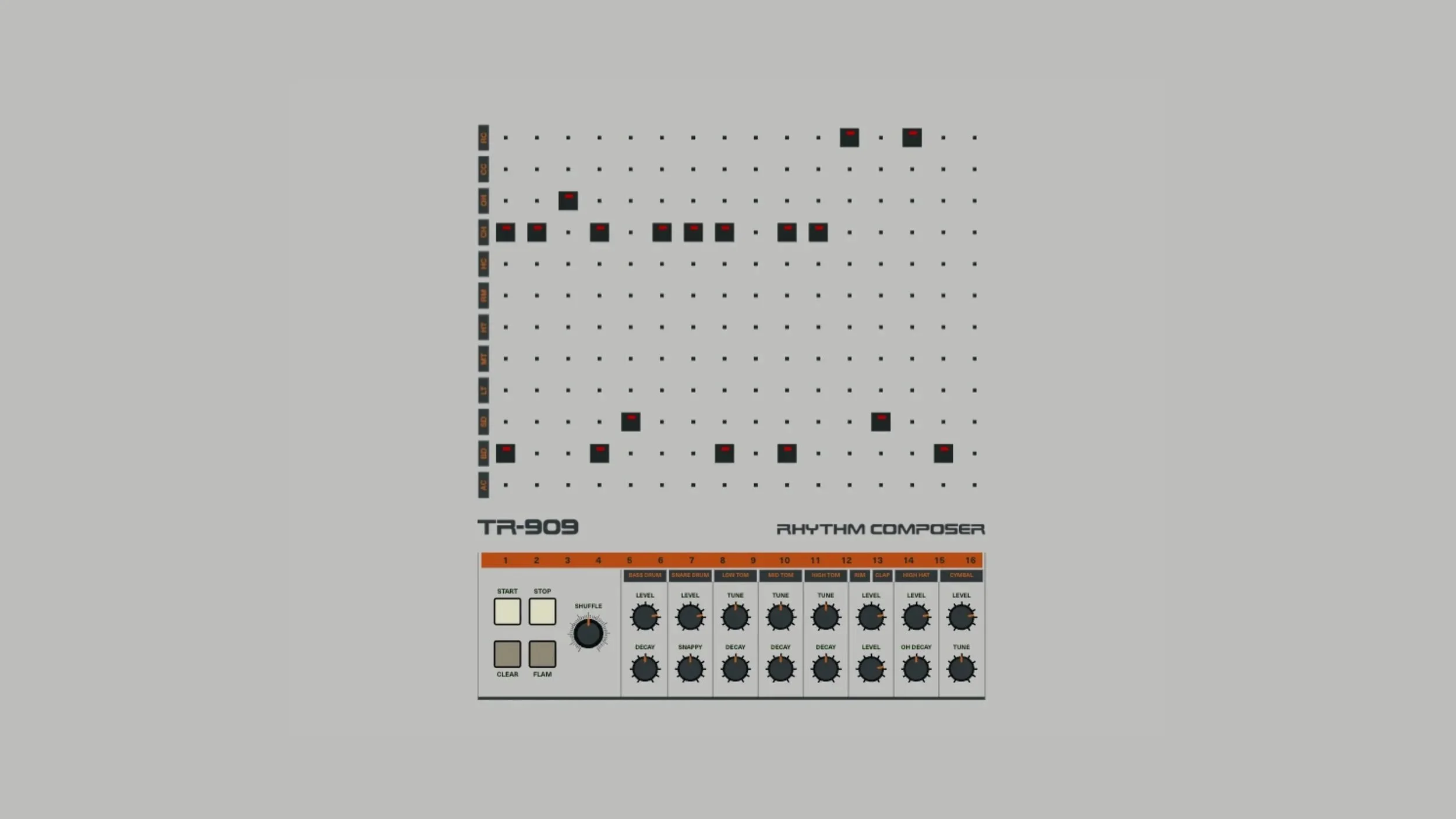
Roland built the TR-909 as a hybrid analog/digital follow-up to the 808, aimed at a market that wanted something closer to a "real" drummer — it sold poorly and production stopped after about a year. What survived on the used market is the opposite of what Roland intended: a synthesized kick and snare paired with sampled cymbals that became the rhythmic backbone of Chicago house and Detroit techno, and pretty much every four-on-the-floor genre since. That's why the 909 sound still matters here, not as nostalgia but as the default reference point for how a four-on-the-floor kit is supposed to feel, in the studio and in the booth. Original units run well into four figures when they show up at all on second-hand platforms, which is why the emulation market around this one box is so deep — official software, third-party VSTs, clones at every price point, even free browser toys. This list skips the sample-pack route (covered elsewhere on the blog) and sticks to the plugins and drum machines actually worth putting in a house or techno setup right now.
Quick Picks
Most authentic VST: Roland Cloud TR-909
Best mix-ready VST: D16 Drumazon 2
Best free plugin: BPB Cassette Drums
Best flagship hardware: Roland TR-1000
Best DJ/live hardware: Roland TR-8S
Best budget analog hardware: Behringer RD-9
Best travel hardware: Roland T-8 Beat Machine
Best VST Plugins
Roland Cloud TR-909
This is where the authenticity conversation starts and often ends. Roland's official plugin runs on ACB (Analog Circuit Behavior) modeling, simulating the original's actual circuit paths rather than just sampling the output — important for a machine whose analog kick and snare interact in slightly unpredictable ways. The cymbals use the same ROM samples as the 1983 original, so nothing feels like a mismatched hybrid.
The other draw is the step-sequencer workflow: programming with accents and shuffle the original way builds a different relationship to groove than dragging MIDI blocks, which matters in genres where pocket is the whole point. It's sold via Roland Cloud subscription but also available as a standalone Plugin Boutique purchase.
D16 Group Drumazon 2
Where Roland's plugin chases historical accuracy, Drumazon 2 is built for a sound that's already halfway mixed. Every drum voice ships with its own EQ, distortion, reverb, delay, and limiter, so a kick that needs to survive a layered, sidechained club mix gets shaped inside the instrument instead of through three bolted-on plugins.
The engine itself is close enough to hardware that most A/B tests come down to taste, but the internal sequencer — flams, ruffles, pattern-following behavior — is what keeps people using it long-term. One plugin, raw or polished depending on how hard you push the processing.
BPB Cassette Drums (Free)
Not every project needs a full emulation. Bedroom Producers Blog's free bundle rolls 808, 909, and 606 kits into one lightweight instrument, each offered in Clean, Warm, and Hot flavors — Warm and Hot are resampled through analog tape for built-in saturation.
It won't replace Drumazon or ADM for a finished record — no deep sequencer, just solid samples in a simple interface — but as a zero-cost way to sketch ideas with real 909 character, it earns a permanent template slot.
Roland50.studio
Not a plugin, and not for finished work, but worth knowing about because it's free and runs entirely in a browser tab. Built by Yuri Suzuki with Roland's engineers for the company's 50th anniversary, it recreates the 909 alongside the 808, TB-303, SH-101, and more — no install, no login.
The real use case is idea capture and demoing, not track-building: testing a pattern on a laptop without your DAW open, or showing someone why the kick-hat relationship works. You can even record and export what you make.
Best VST Plugins
Roland TR-1000
The newest and most significant hardware release here. It's Roland's first partly analog drum machine in decades, combining real analog circuitry for the 909 and 808 engines with ACB modeling on top — actual analog signal path, not a full digital approximation.
What separates it from a pure reissue is everything built around that core: FM synthesis, SP-style sampling, a deep sequencer, and effects including an analog filter and overdrive. Priced for someone who's already decided hardware matters to their workflow.
Roland TR-8S
For DJs and live performers, the TR-8S earns its place through how it behaves under your hands mid-set. It bundles ACB-modeled 909, 808, 707, 606, and CR-78 engines with color-coded pads, dedicated faders, and per-channel effects for dropping sounds in and out live.
That hands-on layer makes it a performance instrument, not just a sound module — build a simple loop, then reshape it in real time for four minutes. Digital underneath, so purists chasing circuit-level accuracy will still prefer the TR-1000 or a true clone.
Behringer RD-9
The RD-9 exists to put true analog-circuit 909 behavior within reach of producers who can't justify TR-1000 money. Behringer modeled the original circuitry component-for-component, so the kick has that same physical thump and the snare/hats carry the same slightly unstable analog character.
Not a pure clone, though — a wave designer and dual-mode filter let you push further than 1983 allowed. Most accessible route to genuine analog 909 hardware today. Want it Eurorack-friendly instead? The RS-9 uses the same sequencer core.
Roland T-8 Beat Machine
The T-8 solves a different problem: portability. Part of the AIRA Compact line, it packs analog circuit-modeled 808, 606, and 909 sounds plus a TB-303-style bassline synth into a backpack-sized unit running on USB or batteries.
Good for exactly the situations where a full drum machine doesn't make sense — sketching a groove on the road, between DJ sets, or feeding a modular rig without hauling gear. Won't replace a full box back in the studio, but fills a real gap cheaply.
VST or Hardware: What Actually Matters for DJs vs. Producers
The trade-off isn't sound quality anymore — most of the software here is close enough that it comes down to workflow. Producers generally want the mix processing VSTs like Drumazon build in, so drums arrive closer to club-ready. DJs and live performers want physical triggering — faders and pads you can grab mid-set without looking at a screen, which no plugin replicates. If you do both, it's less "pick one" and more "which context are you optimizing this session for."
How the 909 Sits Differently in House vs. Techno
The engine's the same, but the role shifts by genre. In house, the 909 tends to sit further back — swung, a little softer, letting the hats and off-beat elements carry the groove. In techno, it usually moves upfront and gets pushed harder: distorted, doubled, sometimes layered with a second kick for more low-end weight. Worth keeping in mind when you're deciding how much processing (Drumazon) vs. raw signal (ADM, hardware) actually fits the track you're building.
Disclosure: This site contains affiliate links. If you purchase through these links, I may earn a commission at no extra cost to you.