
Best Microphones for Podcasting in 2026 (For Producers Who Already Have a Studio)
If you have a home studio, you might have a few mics in your locker already — a condenser you trust for vocals, an interface with spare inputs, a room that sounds fine for a quick take. None of that guarantees good podcast audio. A condenser built to catch every breath of a sung line will just as happily catch the fridge hum and the room's reflections — fine for a demo, worse over ninety uninterrupted minutes with no music bed to hide behind. That's the real shift coming from music into podcasting: it's not a shorter, easier version of vocal recording, it's a different problem. A take is controlled — you comp the best few seconds and bury the rest in a mix. Consistency and noise rejection matter more than fidelity here, which is why your instincts from the booth can point you at the wrong mic. This isn't a beginner guide. You know a ribbon from a dynamic. What's useful below is which mic solves the problem your setup actually has — or whether you need one at all.
Disclosure: This post contains affiliate links. Internet Tattoo may earn a commission if you buy through them, at no extra cost to you.
Last updated: September 2026
Do you even need a new mic?
If you've got a large-diaphragm condenser you already use for vocals — an AT2020, an sE X1, a Rode NT1 — it'll technically work for podcasting. The problem is sensitivity: condensers are built to capture a wide frequency range and pick up quiet detail, which is exactly what you want on a vocal take and exactly what you don't want on a podcast recorded in a living room. Every AC unit hum, every hard-surface reflection, every footstep two rooms over gets captured along with your voice.
Dynamic mics are less sensitive by design and typically use a tighter cardioid pattern, so they reject more of what's happening around them. That's the whole reason "podcast mic" and "dynamic mic" are almost synonymous — it's not that dynamics sound better, it's that they're more forgiving of bad rooms.
If you're plugging into an interface you already own
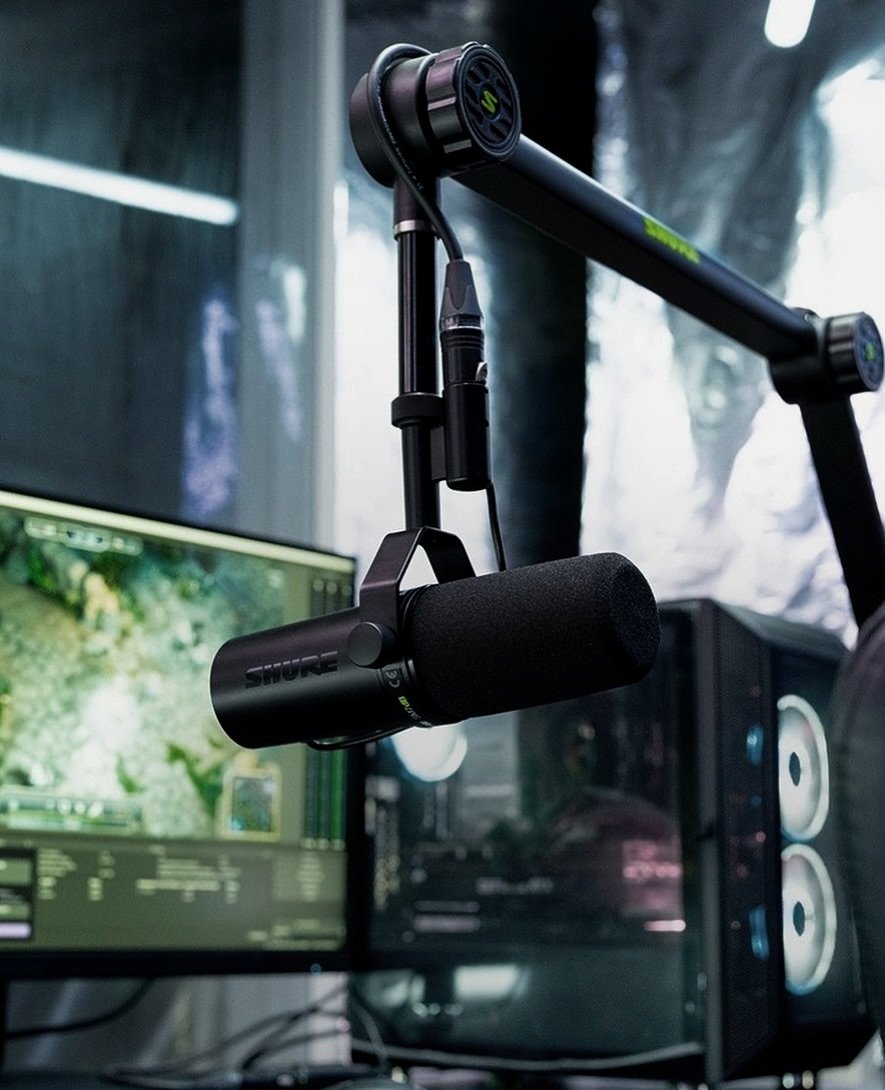
Shure MV7+ — USB + XLR · dynamic, cardioid The DSP is the actual selling point here: real-time denoising and a digital pop filter run before the signal even hits your DAW, which matters if you're recording somewhere that isn't your treated vocal space. It also runs USB and XLR simultaneously — plug it into your interface for the main take and into your laptop as a backup recording at the same time, so a crashed session or a bad gain setting doesn't cost you the whole episode. Max SPL is high enough that close-mic technique won't clip it, though there's no hardware low-cut switch — handle low-end rumble in software instead.
Rode PodMic — XLR only · dynamic, cardioid The built-in swing mount and internal pop filter mean you're not buying a separate boom arm attachment or pop shield just to get started. Its main practical advantage over pricier broadcast dynamics: it doesn't need a Cloudlifter or similar gain booster to sound decent off a mid-range interface, which the SM7B and RE20 effectively require. If you want an XLR dynamic without adding a gain-boosting box to your signal chain, this is the one.
If you're skipping the audio interface entirely
Shure MV7+ — same mic as above, over USB. If there's any chance you'll want XLR later, this is the one that doesn't box you in.
Audio-Technica ATR2100x-USB — USB + XLR · dynamic Older design, still solid. Like the Samson Q2U it's often compared to, it supports simultaneous USB and XLR output, so you can run a backup recording the same way described above with the MV7+. Tonally it leans a little nasal with a lighter low end — not a dealbreaker for spoken word, but worth knowing before you commit if you've got a deeper voice.
Shure MV6 — USB only · dynamic, cardioid Compact and aimed at streamers, with built-in headphone monitoring and a moving-coil capsule tuned for voice isolation — so it gets the same room-forgiveness as the other dynamics here, just without an XLR option. The main reason to pick this over the ATR2100x-USB is the gaming/streaming-oriented controls (onboard mute, mix balance for game audio) if that's part of your setup; if it isn't, the ATR2100x-USB does the same core job for less.
One to skip
Blue Yeti — It's a condenser with switchable cardioid, bidirectional, omnidirectional, and stereo patterns, which sounds like flexibility but usually just means more ways to get it wrong. Left on omnidirectional by accident, or used from two or three feet away instead of close up, it picks up exactly the room noise a dynamic mic exists to avoid. If you already own one, switch it to cardioid and get closer before assuming the mic is the problem. If you're buying new, get one of the dynamics above instead.
Why isn't the SM7B on this list?
Hot take alert: For a producer building a podcast setup, the SM7B isn’t a good choice.
The sound is real — that dark, controlled broadcast character is legitimately good, and it's a big part of why it's become the go-to for podcasters and streamers everywhere. But the SM7B has famously low output. It needs far more clean gain than a standard interface preamp is built to supply, and pushing a normal interface hard enough to compensate usually adds noise and hiss instead of the smooth low end you're after.
The standard fix is an in-line gain booster — a Cloudlifter, a FetHead, something similar — which means another box, another cable, and another point where something can go wrong mid-recording. Shure effectively admits this is a real problem: the SM7dB exists specifically to bolt on an active preamp and solve it, at a higher price than the original mic.
None of the picks above have that issue. The MV7+ comes from the same design lineage and shares the SM7dB's DSP approach without the premium, and the Procaster and PodMic both run fine off a standard interface with no extra gear needed. Skipping the SM7B doesn't mean giving up the broadcast-dynamic sound — it just means skipping the extra box in your signal chain.
If you already own an SM7B and a Cloudlifter, keep using it — it's a great mic once that problem is solved. If you're buying from scratch, the cost and hassle of the gain booster changes the math on whether it's the practical choice or just the recognizable one.
FAQ - Quick answers
Do I need a new mic if I already record vocals? Only if your room isn't treated. See the section above.
USB or XLR for podcasting? XLR through an interface you already own gives you more control and isn't locked into one connection type if your setup changes. USB is fine if you're recording solo and want zero extra steps.
Do I need a Cloudlifter or gain booster? Only for the notoriously low-output broadcast dynamics like the SM7B or RE20. Everything on this list runs fine off a standard interface without one.
Can I record two hosts on one interface? Only if it has two mic inputs. A single-input interface built for solo vocal tracking will force you into USB mics or an upgrade if you're bringing on co-hosts.
Last updated: September 2026
Disclosure: This blog contains affiliate links, which means Internet Tattoo may receive a commission if you purchase through these links at no additional cost to you.