
Goodhertz LA-210: A Free Plugin Built for Colorful Imperfection
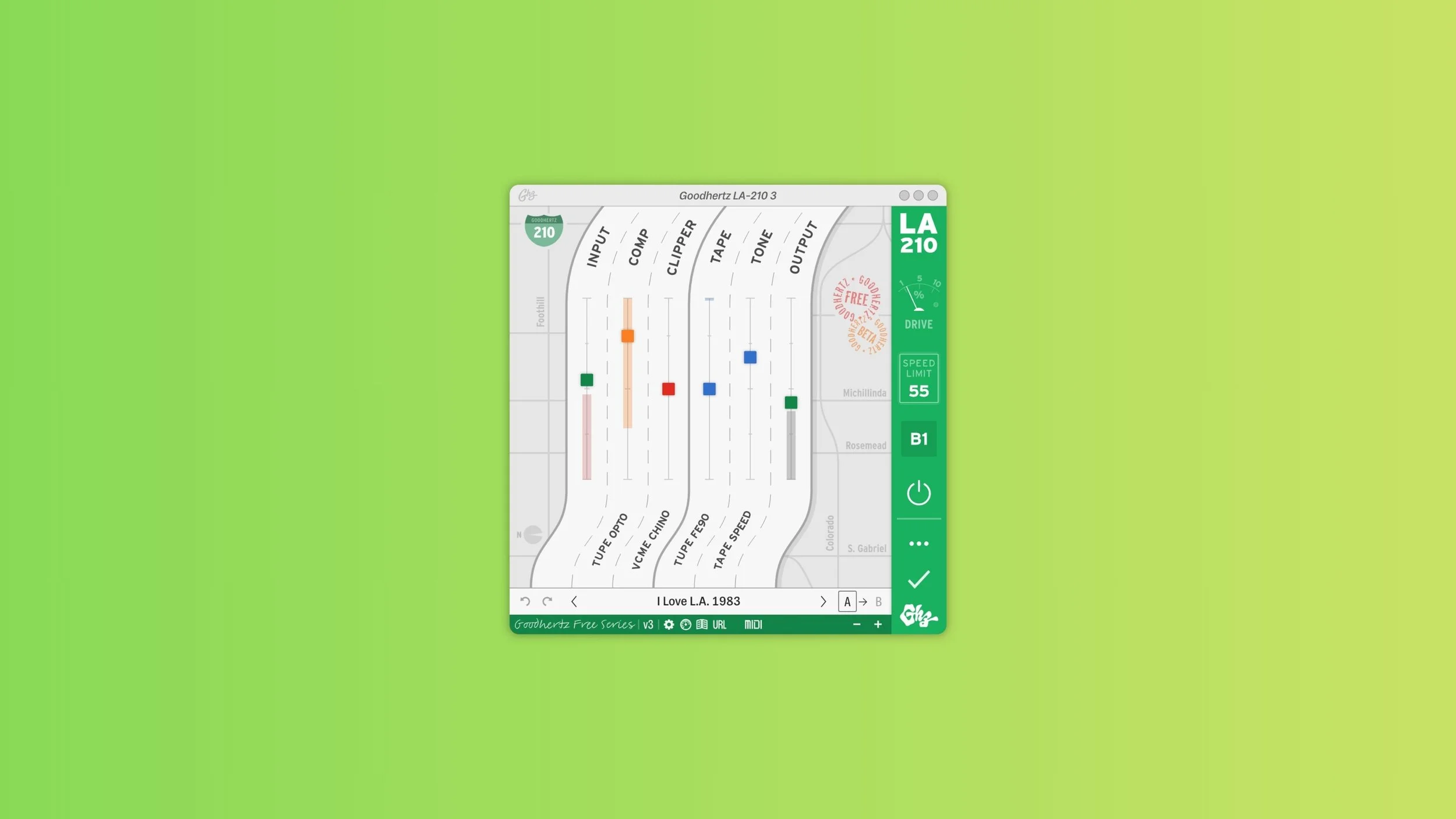
Goodhertz dropped a free plugin in May 2026 and it's worth knowing about. The LA-210 bundles four modules from their paid catalog — optical compression, soft clip saturation, a cassette tape model, and a brickwall limiter — into a single unit. The UI is built around a Southern California freeway map, the name comes from the 210 Freeway near their office, and of course nods to the LA-2A. The whole thing is free with a Goodhertz account. What makes it interesting isn't the price. Goodhertz has been making precise, transparent software for years — modern tools that do exactly what they say and don't try to add color unless you ask. The LA-210 is a deliberate departure from that: it's built for character, not clarity. That's a different thing from them, and it's worth understanding what they put into it and why.
Some context on Goodhertz
Goodhertz isn't a company that chases trends. Their catalog — Vulf Compressor, Tupe, Lossy, Faraday Limiter — is precise and opinionated. Their plugins don't try to look like hardware. No skeuomorphic knobs, no fake VU meters. They look like software, and that's been a consistent design stance across everything they've released.
Which is what makes the LA-210 a bit of an outlier. Their own description of it — "designed for character, grit, and intentional signal destruction" — doesn't sound like the company that makes Loudness, one of the cleaner and more useful free metering tools available. But the character modules in the LA-210 aren't new code. They're components pulled directly from plugins Goodhertz already makes and sells. The departure here is more about framing and intent than about building something technically different from their usual work.
What's inside it
The LA-210 is a fixed signal chain built from four modules, each pulled from an existing Goodhertz paid plugin. It's not new processing — it's a specific assembly of things they've already built, packaged as a single free tool. The chain runs like this:
Opto Compressor — Pulled from Tupe, their tape and optical compression plugin. This is smooth, musical leveling — the kind of compression that breathes rather than clamps. It handles dynamics without calling attention to itself, which makes it a good anchor for everything that comes after it.
Soft Clip Saturation — This is the "Chino" mode from VCME (Vulf Compressor, Mastering Edition), and it's where things start to get interesting. Tube-like harmonic saturation, the kind that adds density and warmth rather than obvious distortion. Push it and you'll hear it. Keep it subtle and it just makes things feel more present.
Tape Model — The FE90 cassette emulation from Tupe Wow, including tape speed controls. This is where the lo-fi character lives: frequency roll-off at the top end, a hint of wobble, the sonic signature of a medium that was never designed to be high-fidelity. It's an affectionate degradation.
Limiter — The brickwall limiter from VCME closes the chain. It keeps things from getting out of hand when you're pushing the earlier stages hard, which you will.
The order matters. It's a compression-into-saturation-into-degradation-into-limiting chain, which is a fairly logical way to stack these kinds of processes. You'd build something similar manually if you were pulling from each of these plugins individually — the LA-210 just collapses it into one place.
The interface
Goodhertz is based in the northern San Gabriel Valley, and the 210 Freeway runs through that part of Los Angeles. The UI is designed to echo a freeway map of Southern California — which is either an interesting design choice or a piece of trivia, depending on how much you care about that kind of thing. Their framing is that it's "as free as the freeway," which is a reasonable enough tagline for a free plugin named after a road.
The controls are sliders, not knobs — consistent with how Goodhertz generally approaches interfaces. No gear-worship aesthetic, no vintage styling. It's designed to be used quickly rather than admired. The freeway map layout is more visual concept than literal navigation aid, but it gives the UI a distinct identity without making it harder to use.
The Goodhertz Free Series
Goodhertz has a small collection of free plugins that's been growing quietly alongside their paid catalog. The existing tools are both utilities: Loudness is a metering plugin built around broadcast and streaming loudness standards, accurate and straightforward. Midside Matrix handles mid-side encoding and decoding — useful in specific mixing and mastering contexts, and not something every DAW makes easy to do natively.
Both of those tools are transparent by design. They don't add anything to the signal; they help you measure or route it. The LA-210 is the first free Goodhertz plugin that's explicitly about adding something — texture, saturation, degradation. It's a different kind of tool from what they've offered for free before, which suggests the series is expanding beyond utility into something with more range.
Where to get it
The LA-210 launched in beta in May 2026. Goodhertz is collecting feedback and the plugin may change — features could be added, behavior adjusted. It's a working release, not a finished one, though it's functional enough to use now.
It runs on Mac (AU, AAX, VST, VST3) and Windows (AAX, VST, VST3), 64-bit only. A Goodhertz account is required to download it, which is a standard ask for their free series and gets you into their ecosystem. That part is obviously good for them, but the plugin itself holds up on its own terms — it's not a stripped-down demo or an advertisement for something else. It's a complete tool that happens to be free, built from real components of their paid work, and released by a company that seems to have made it because they wanted to.
Disclosure: This site contains affiliate links. If you purchase through these links, I may earn a commission at no extra cost to you.