
Universal Audio Paradise Guitar Studio: Amps, Pedals, and More
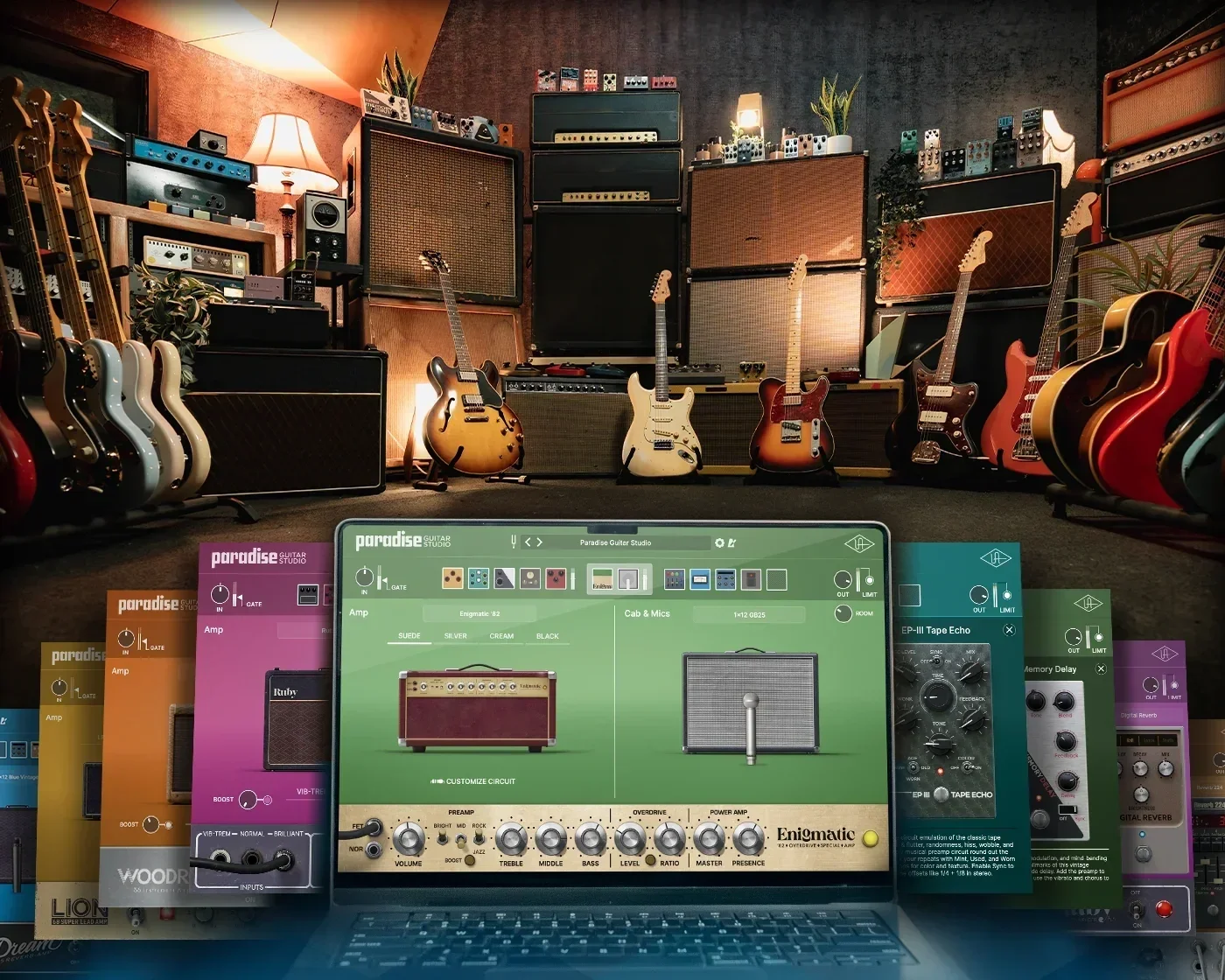
Amp sims have been evolving for years, but most of them still feel like collections of separate parts—amps here, pedals there, cabs in another window—leaving the player to assemble a workable signal chain from scratch. Paradise Guitar Studio changes that equation by treating the entire process as one unified environment. Instead of thinking in terms of modular components, Universal Audio presents the plugin as a fully formed virtual studio, where the whole chain is designed to work together, respond together, and make it easier to land on polished, mix-ready tones without the usual tweaking marathon. It’s meant to feel like stepping into a single creative space where every piece is already dialed for you. This matters because in-the-box guitar recording has become the norm for producers, songwriters, and session players working from home. Paradise slots into that world by offering a curated set of amps, cabs, mics, and effects that carry UA’s familiar studio pedigree, but in a way that’s fast and immediately workable. The pitch is simple: instead of scrolling through endless gear models, you just open it, pick a direction, and play. With everything contained in one plugin, Paradise aims to be more than an amp sim—it’s trying to be the place where your guitar tracks start and, ideally, finish.
Disclosure: This site contains affiliate links. If you purchase through these links, I may earn a commission at no extra cost to you.
What Paradise Guitar Studio Is
Paradise Guitar Studio is Universal Audio’s first attempt at an all-in-one guitar processing ecosystem, and you can feel that ambition the moment you load it. Rather than functioning like a typical amp sim, it behaves more like a curated studio signal chain where the stages—input tools, amps, cabs, effects—flow in a way that feels natural and musical. It’s a native plugin, meaning you don’t need UA hardware, but it still carries the same aesthetic and sonic footprint UA is known for: smooth, analog-leaning, and built for producers who want high-quality tones without getting lost in menus or technical setup.
The entire interface reflects that philosophy. Everything is laid out visually, with your chain presented as a single, scrollable environment that encourages exploration without confusion. UA isn’t trying to overwhelm you with endless choices; instead, it aims to offer enough tonal coverage to fit almost any style without burying you in options. For players who want something that feels premium but approachable—something that replaces 10 different plugins with one cohesive workspace—Paradise is designed to be that turnkey solution.
The Sound Engine: Amps, Cabinets & Mic Modeling
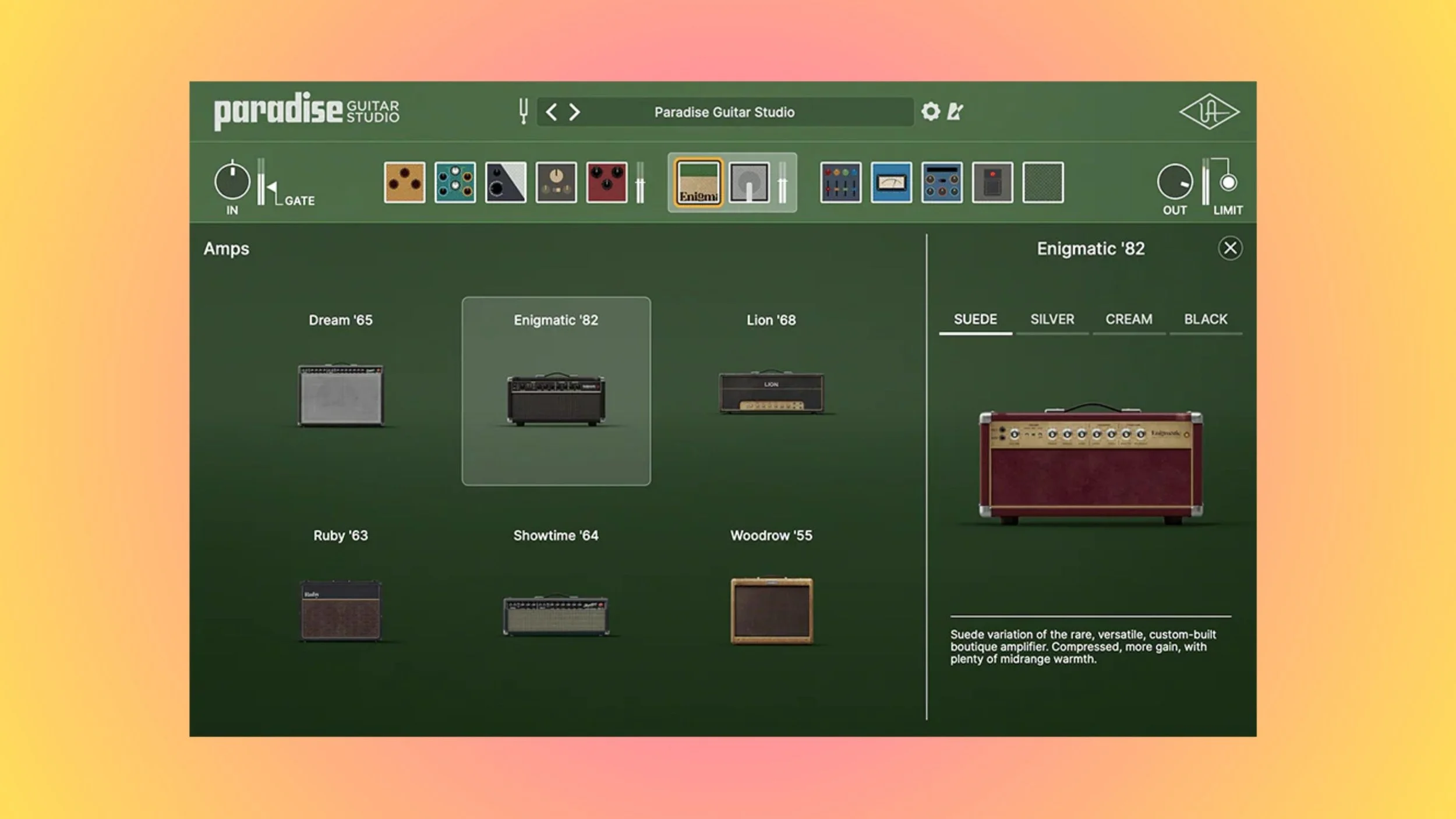
At the center of Paradise is a roster of 11 amps that cover clean sparkle, mid-gain crunch, boutique edge, and heavier saturation. UA doesn’t advertise them as direct clones of famous circuits, but the inspirations are clear: American cleans, British chime, modded hot-rod tones, and a few boutique flavors that lean toward expressive, touch-sensitive playing. What stands out is how dynamic they feel; the gain stages react in a way that rewards nuance and doesn’t collapse into harshness or fizz. You can push them, clean them up with your volume knob, and get the kind of responsiveness that gives digital amps a sense of life.
The cabinet and microphone section is equally refined, offering a thoughtful set of pairings that sound realistic without drowning you in mic-angle micro-adjustments. It’s more streamlined than some deep-editing competitors, but deliberately so—Paradise wants you to focus on musical decisions, not engineering exercises. The mics offer tonal variety, the cabs feel full and dimensional, and everything hits the sweet spot between flexibility and efficiency. Instead of trying to replicate the chaos of a real mic’d room, Paradise leans toward polished, studio-ready consistency, which is exactly what many producers want.
Effects & Workflow: Building a Full Guitar Chain
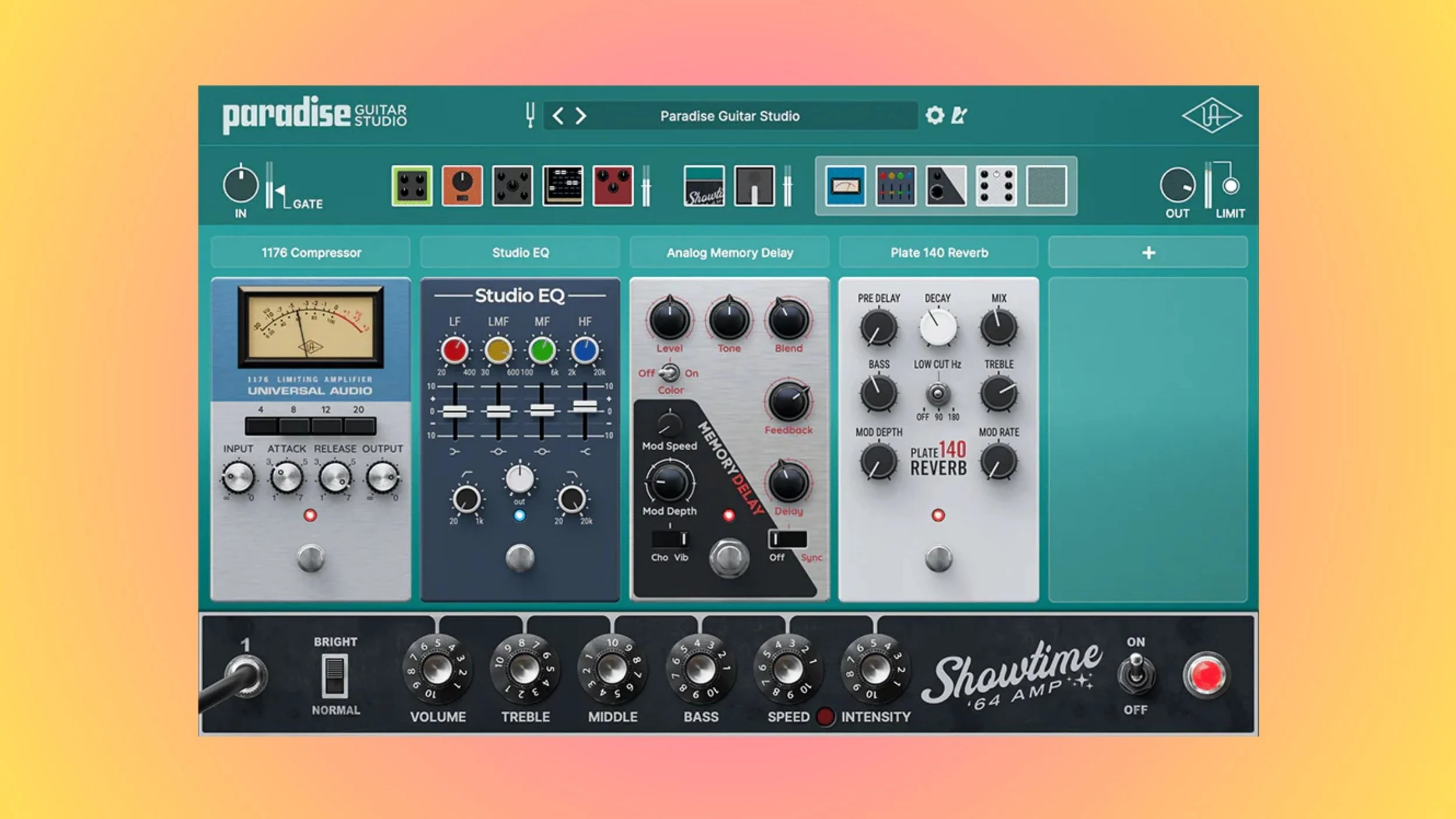
One of the biggest strengths of Paradise is the effects section, which brings together stompboxes and studio processors in a way that feels coherent. You get drives, modulation, tape echoes, reverbs, EQs, compression—including 1176-style tools that UA is known for—and utility effects like gates and limiters. These aren’t afterthought modules; they feel like serious, mix-quality tools you could use on their own, which makes the plugin just as suitable for shaping a final guitar tone as it is for fast demoing. The palette is broad, but everything stays musical and intentional, making it easy to build chains that feel natural.
Workflow-wise, the drag-and-drop routing lets you experiment without wrestling with the interface. Presets are extensive—more than 300—and they cover not only genres but also production scenarios, from ambient soundscapes to punchy modern rock. The interface feels uncluttered, and the animations and visual hierarchy make it obvious what you’re adjusting at any moment. Paradise doesn’t just offer a lot of tools; it tries to make them feel like one instrument, which is something that many guitar plugins still struggle to achieve. Whether you’re tracking fast ideas or sculpting tones for release, the workflow feels deliberate and enjoyable.
Who It’s For (and Who It Isn’t)
Paradise Guitar Studio is ideal for guitarists and producers who want polished tones quickly without sacrificing depth. If you work from a home studio, track guitars for your own productions, or jump between genres, this plugin gives you a clean, consistent environment where everything just works. It’s especially strong for indie, pop, alt, and rock contexts where clarity, dynamics, and subtlety matter more than brutal metal saturation. Songwriters will appreciate how quickly they can get something that sounds convincing, and producers will value how well the tones sit in a mix without excessive processing.
On the other hand, Paradise isn’t trying to satisfy every corner of the guitar world. Players who thrive on the chaos and physicality of real amps might feel limited by the curated nature of the options. Metal players who depend on ultra-high-gain precision might find deeper offerings elsewhere. And people who prefer the sandbox-style editing of modelers like Helix Native or Amplitube might wish UA had gone even further with customization. Paradise is about balance and usability; if you’re chasing extreme tonal specificity or re-amping workflows, this might not be your forever tool—but for many, it will be more than enough.
Alternatives to Consider
If you want the most flexible “do-everything” guitar environment, Guitar Rig 7 Pro is still the all-rounder to beat. Its strength isn’t just the number of amps or effects, but how creatively it lets you route, modulate, and combine them. Native Instruments leans into experimentation, giving you tools that range from classic amp models to granular effects, sequenced modulators, and wild sound-design utilities. For producers who want one plugin that can sound traditional one minute and completely unhinged the next, Guitar Rig remains a versatile and endlessly expandable option that adapts to almost any style or workflow.
For players who care about exact amp families, model variations, and massive gear variety, AmpliTube 5 MAX offers one of the deepest libraries on the market. The scale of the ecosystem—amps, pedals, cabs, rooms, mics, artists, collections—is unmatched, and it’s ideal for guitarists who enjoy browsing through specific hardware emulations to find the one that fits. It can be more complex than Paradise Guitar Studio, but if you want sheer breadth and the ability to fine-tune every part of the chain, AmpliTube’s modular environment delivers a level of detail that appeals to tone collectors and studio tinkerers alike.
Meanwhile, Softube Amp Room takes a more purist studio-engineering approach. Instead of overwhelming you with countless models, it focuses on the realism and depth of its components, using Softube’s high-end modeling to deliver tones that feel warm, dimensional, and mix-ready. Amp Room is particularly strong if you think in terms of real studio workflows—placing amps in virtual rooms, pairing them with premium cabs and mics, and shaping the result with pro-grade modules. It’s a powerful option for producers who want cleaner, more engineered tones and who value authenticity over sheer quantity.
Disclosure: This site contains affiliate links. If you purchase through these links, I may earn a commission at no extra cost to you.