
KeyStep 37 MKII: Arturia's MIDI/CV Controller Just Got Better

The Arturia KeyStep 37 MKII is the second-generation evolution of one of the most popular compact MIDI/CV controllers in modern hybrid studios. Sitting between the original 32-key KeyStep and the larger KeyLab series, it occupies a very specific niche: small enough to integrate into modular rigs and tight desktop setups, yet powerful enough to function as a sequencing hub. With a built-in polyphonic sequencer, arpeggiator, scale and chord modes, and deep CV connectivity, it’s long been a favorite for producers who move fluidly between hardware, Eurorack, and DAW environments. The MKII doesn’t abandon that formula — it strengthens it. This version introduces Mutate, Spice, and Phrase Arpeggiator modes, adds pattern chaining and unquantized recording, expands modulation routing with a new Mod 2 CV output, upgrades connectivity to USB-C, and enhances interaction with a clickable OLED encoder, additional physical controls, and a 39-LED light guide. Rather than reinventing the KeyStep concept, Arturia has pushed it further toward being a compact creative engine — one that encourages variation, live manipulation, and seamless translation between MIDI and CV workflows.
Thinking the KeyStep 37 could fit your rig? Check price here
Design & Interface Changes
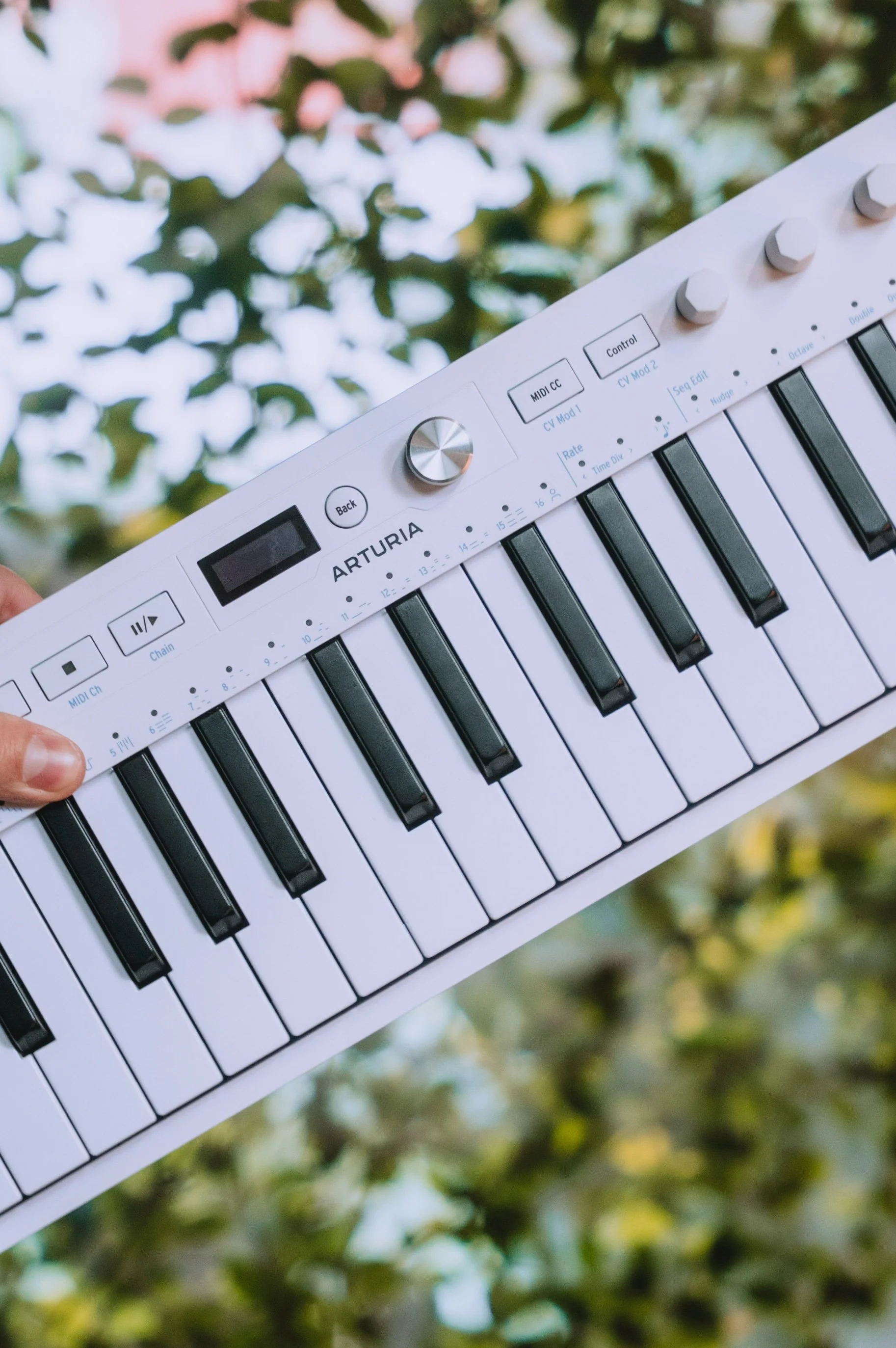
With the KeyStep 37 MKII, Arturia hasn’t changed the footprint — it’s still compact, still modular-friendly, still built for tight desks and live rigs — but the surface has clearly been rethought. The MKII adds four additional encoders, two extra buttons, a clickable encoder with an OLED screen, and a 39-LED light guide above the keybed. That’s not cosmetic. It shifts how you interact with the device. Instead of feeling like a minimal controller with hidden layers, it now presents more information and control directly in front of you.
The OLED screen and clickable encoder, in particular, change the experience. Combined with the expanded physical controls, navigation becomes more immediate and visually guided. The 39-LED strip above the keys adds performance feedback — especially useful when sequencing or triggering patterns — reinforcing the idea that this version isn’t just a MIDI bridge, but something closer to a self-contained creative instrument. It’s still streamlined, but it feels more deliberate and performance-oriented than before.
Sequencing & Generative Tools
This is where the MKII clearly separates itself from earlier KeyStep models. The sequencer now supports pattern chaining and unquantized recording, two upgrades that dramatically expand what you can do without touching a DAW. Pattern chaining allows you to link sequences into longer evolving structures, making it possible to sketch full arrangements or build live sets directly from the unit. Unquantized recording lets you preserve natural timing and groove, capturing performances with human feel instead of forcing everything into rigid grid divisions.
The real evolution, though, comes from the new generative tools: Mutate, Spice, and the Phrase Arpeggiator. Mutate instantly transforms a sequence or arp into a variation — sometimes subtle, sometimes drastic — without stopping playback. Spice introduces controlled rhythmic randomness, adjustable via Shift + Mod Wheel, keeping patterns evolving and slightly unpredictable. The Phrase Arpeggiator goes beyond traditional up/down modes by looping structured phrases based on held notes, generating more musical and dynamic results. Together, these additions push the KeyStep 37 MKII beyond simple sequencing into something more exploratory — a tool designed not just to play patterns, but to reshape them in real time.

Playability & Keyboard Feel
The KeyStep 37 MKII keeps the slim 37-note format that defines the series, offering velocity-sensitive keys with aftertouch in a compact footprint. That combination continues to be one of its biggest advantages in this size category. Thirty-seven keys give you enough range for proper chord voicings, bass-and-lead splits, or two-handed ideas, without crossing into full controller territory. It’s small enough to live in front of a modular case or beside a laptop, but wide enough to feel musically complete.
The slim key design clearly favors synth-style responsiveness over piano realism, and that’s intentional. This isn’t meant to replicate weighted action — it’s built for fast parts, expressive pressure gestures, and modulation-driven performance. When paired with hardware or modular systems that respond to aftertouch and velocity, the MKII becomes more than a note entry device. It becomes an expressive performance controller, especially in setups where CV modulation assignments turn pressure and dynamics into movement inside a patch.
Software Integration, Connectivity & Expandability
The KeyStep 37 MKII is clearly designed as a bridge between worlds. On the digital side, it now connects via USB-C, modernizing computer integration while maintaining tight DAW control and MIDI functionality. Traditional 5-pin MIDI In and Out remain intact, meaning it can still sit comfortably between drum machines, desktop synths, and rack gear without adapters or compromises. This isn’t a controller locked into one ecosystem — it’s intentionally format-agnostic.
Where it becomes especially interesting is on the modular side. The MKII provides CV Pitch, Gate, Mod 1, and the newly added Mod 2 output, along with Sync I/O and pedal input. That second modulation output is more than a spec bump — it expands how you route expressive data into Eurorack or semi-modular systems. You can assign modulation sources like velocity, aftertouch, mod wheel, per-step random, or pulse per step to the CV outs, turning the KeyStep into an active modulation brain rather than just a note trigger. In hybrid studios — laptop + hardware + modular — this is exactly the kind of connectivity that keeps workflows fluid instead of fragmented.
Sequencer Alternatives to Consider
If you’re looking at the KeyStep 37 MKII primarily for its sequencing power, it’s worth comparing it to dedicated hardware sequencers that go deeper into pattern control and multi-track hardware integration. The Arturia BeatStep Pro is a performance-focused sequencer that swaps keys for pads. It has two independent melodic sequencers (up to 64 steps each) and a dedicated drum sequencer, plus extensive CV/Gate, MIDI, and clock connectivity. It’s built for driving multiple hardware synths and modular systems simultaneously.
The Korg SQ-64 takes a more compact, grid-based approach, offering three polyphonic melodic tracks and one drum track, each up to 64 steps, with multiple CV outputs per track and an OLED display for parameter editing — making it particularly attractive for modular users who want per-track CV control.
The Polyend Play, meanwhile, is a far more expansive grid sequencer and groovebox with 8 audio tracks and 8 MIDI tracks, deep step manipulation, and performance effects. Unlike the others, it includes its own internal sample engine, making it both a sequencer and a standalone production device.
Compared to the KeyStep 37 MKII, all three trade keyboard playability for deeper multi-track sequencing and performance control — they’re less about expressive key performance and more about building and manipulating structured patterns across multiple pieces of gear.
If you like the KeyStep ecosystem, you might also want to consider the cheaper 32-keys KeyStep, or the much more powerful KeyStep Pro. Arturia makes quality product, it’s all about what your needs are!
Pros
Compact 37-key format with velocity and aftertouch
Built-in polyphonic sequencer and arpeggiator
CV, Gate, and MIDI connectivity for modular and hardware setups
Generative and performance-oriented sequencing tools
Improved interface layout
Cons
Limited to one main sequencer track compared to dedicated multi-track sequencers
Slim keys may not suit players who prefer full-size keybeds
Smaller display and menu depth compared to larger workstation-style controllers
Final Words
The Arturia KeyStep 37 MKII doesn’t try to be everything. It doesn’t compete with large-format DAW controllers, and it doesn’t replace deep multi-track sequencers. What it does offer is a compact, expressive keyboard paired with sequencing tools and modular connectivity that feel purpose-built for hybrid studios. It’s designed for producers who move between laptop, hardware synths, and Eurorack without wanting to constantly reconfigure their setup.
If your workflow revolves around expressive playing, fast idea generation, and tight integration between MIDI and CV gear, the KeyStep 37 MKII remains one of the most balanced options in its size class, an incredible value for the price! If you need extensive multi-track sequencing or full-scale DAW mixing control, other devices may fit better. But as a small, capable creative hub, it continues to occupy a very specific — and still very relevant — niche.
Thinking the KeyStep 37 could fit your rig? Check price here
Disclosure: This site contains affiliate links. If you purchase through these links, I may earn a commission at no extra cost to you.