
Arturia Pure SUB: Has Arturia Solved the Low-End Dilemma?
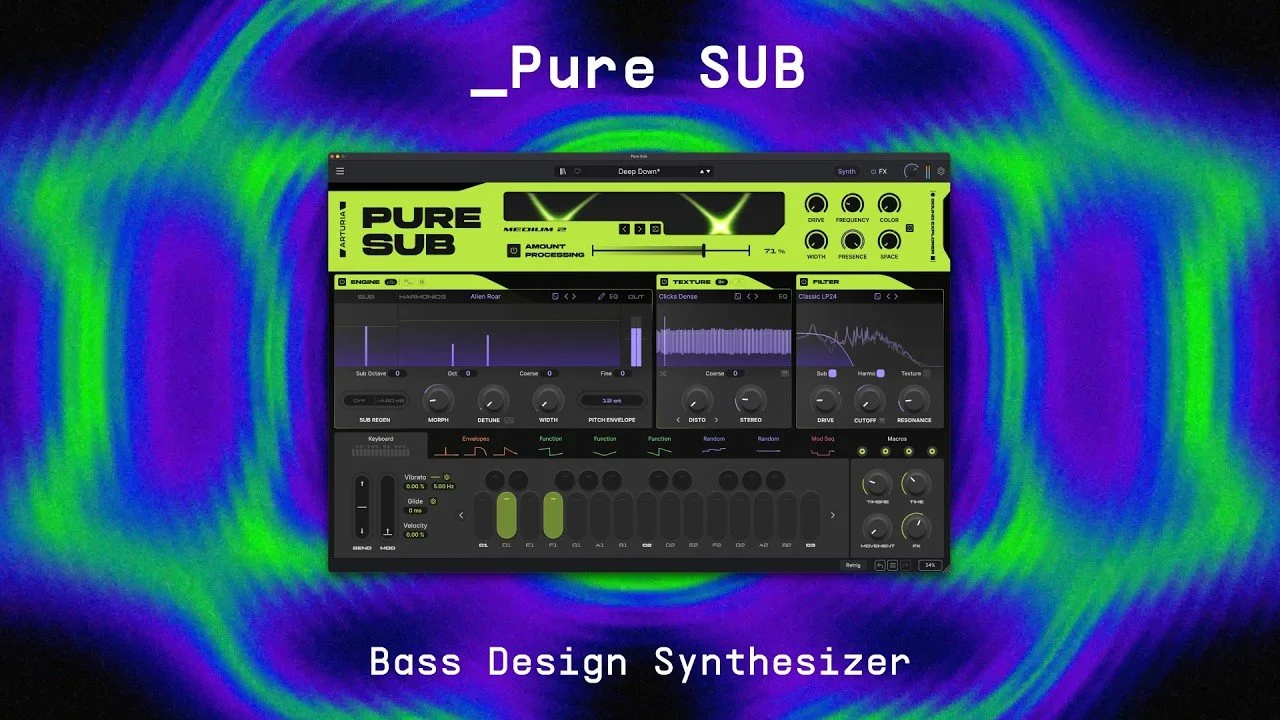
Getting low end right in a modern mix is notoriously frustrating. Every producer knows the routine: you build an 808 or Reese bass, throw saturation on it so it translates to smaller speakers, and watch your sub-frequencies dissolve into a phase-canceled mess. You end up setting up split-processing chains — routing a clean sine to a sub bus while distorting a high-passed duplicate — just to keep the low end from falling apart. Arturia's Pure SUB addresses this problem head-on. Rather than functioning as a general-purpose synth with bass presets bolted on, it isolates your fundamental sub frequency so you can distort, filter, and modulate everything above it without wrecking your mix foundation. Has Arturia solved the low-end dilemma? Let’s dive in!
Click here for more info about Pure SUB
Want even more low-end? Check our post about the top synth bass plugins here
Purpose-Built Architecture
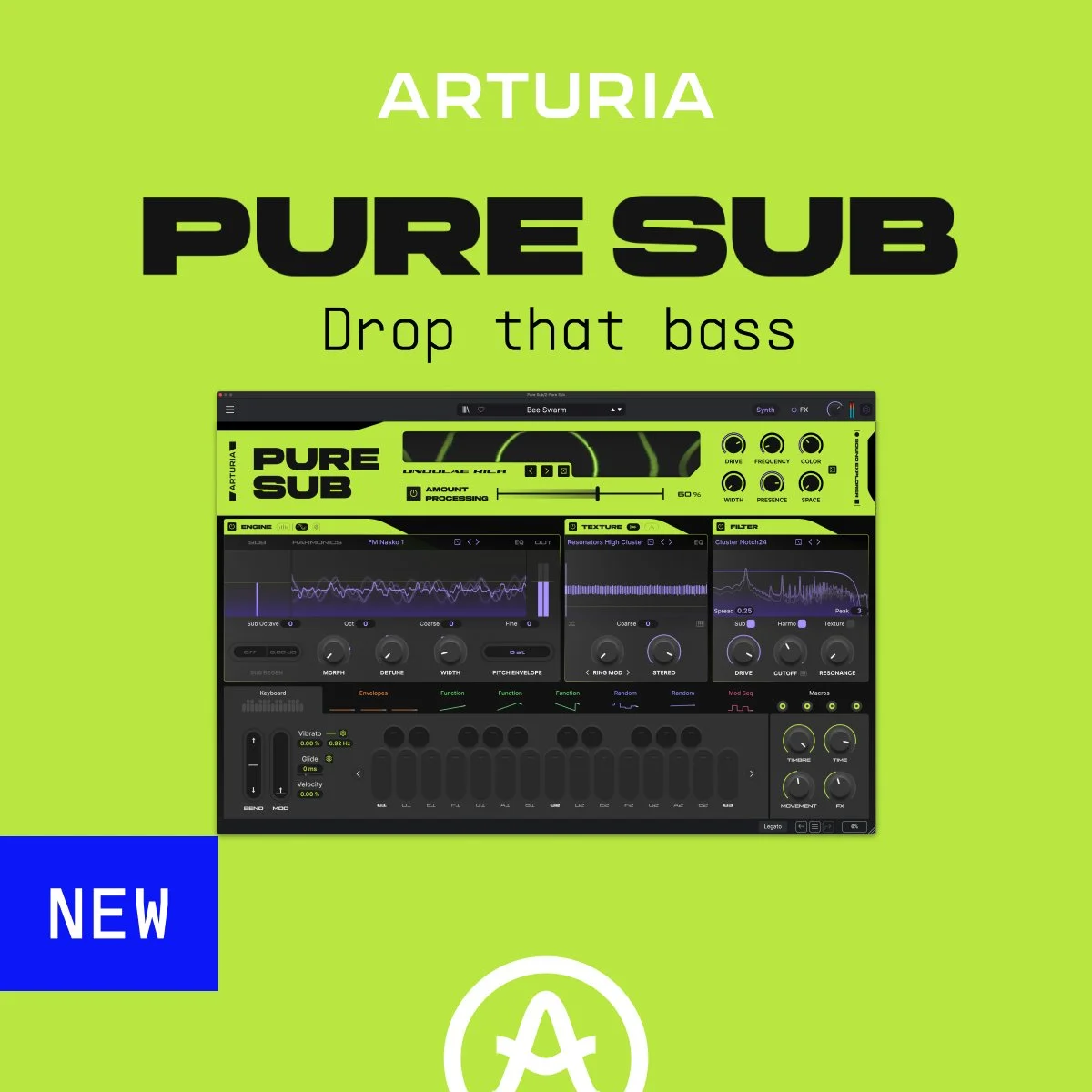
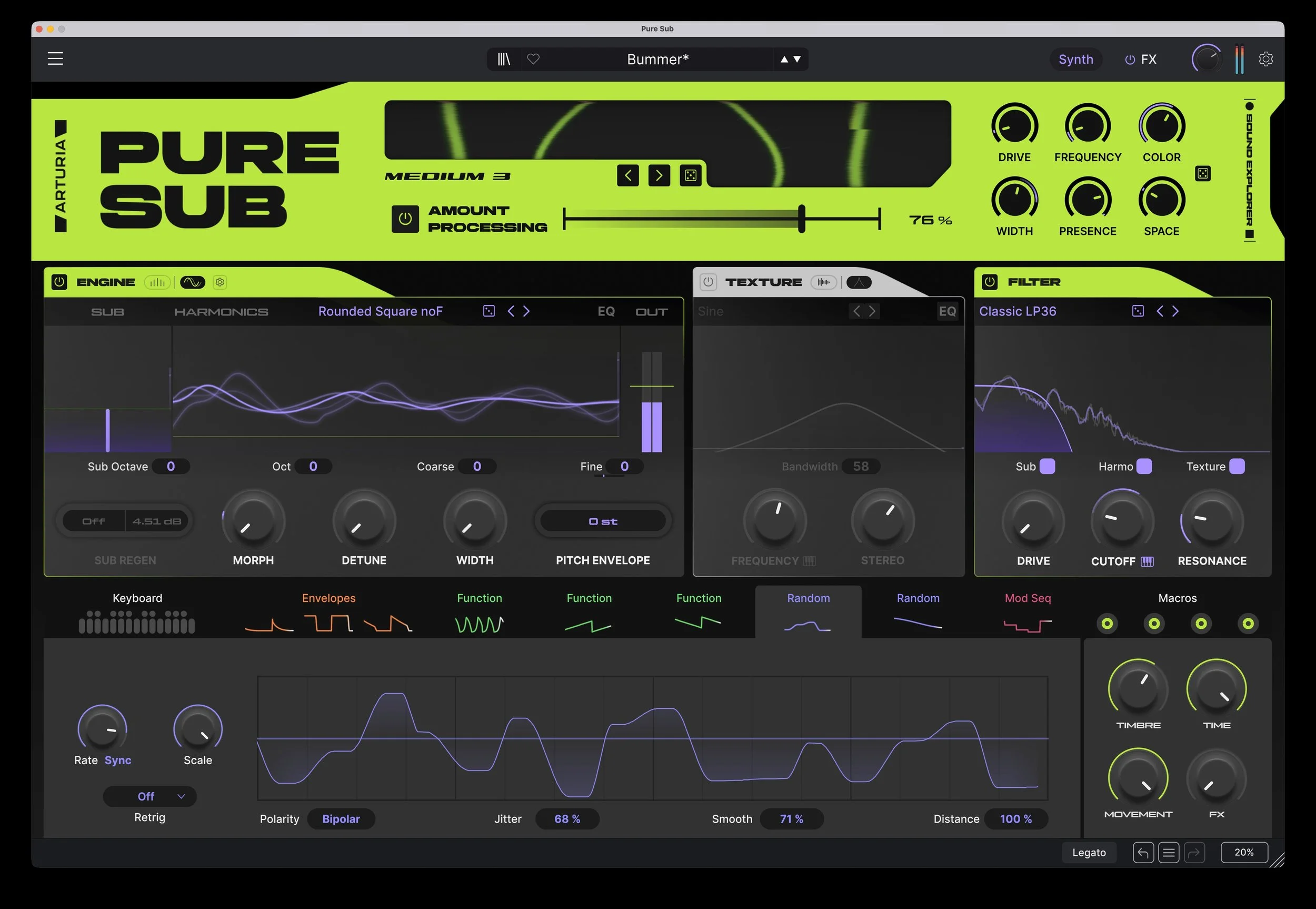
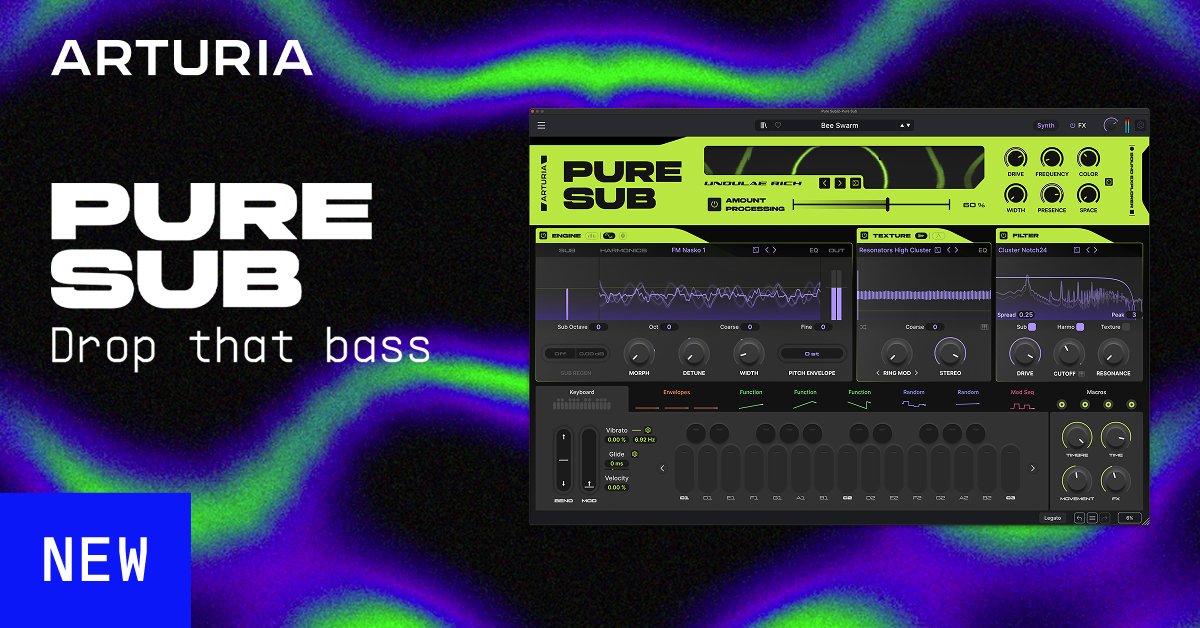
If you've used Arturia plugins before, the drag-and-drop modulation and clean interface will feel familiar right away. But Pure SUB swaps open-ended synthesis for a fixed, three-layer architecture: Sub, Harmonics, and Texture.
Sub controls the fundamental's pitch, phase, level, and octave, independent of everything layered on top.
Harmonics splits into two dedicated engines: Pressure, a low-density harmonic mode with its own custom waveform editor, and Reese, built for wide, high-density unison.
Texture adds grit two ways: blending samples into the fundamental via ring modulation, AM, or distortion, or switching to Corroder mode for key-tracked noise, sine, saw, square, or frequency-modulated sources.
The 300 factory presets lean hard into electronic production — 808 hits, wide Reese tones, aggressive growls — and four macro controls give you fast tonal shaping without disturbing the underlying pitch and sub balance.
The interface itself is worth a mention on its own: from the rave-era aesthetics to the header features patterns that move interactively with the sound, the whole plugin has a modern, alive feel that veers away from the usual reproduction of vintage synths.
How Sub Regen Actually Works
If you push low frequencies through heavy filtering or saturation, you'll usually introduce phase instability and unwanted amplitude shifts — the exact problem that forces most producers into manual split-band routing. Pure SUB's answer is Sub Regen: instead of trying to preserve phase coherence across the whole signal while processing it, Sub Regen lets your sound run through the filter, distortion, and FX chain freely, then swaps in a clean, phase-stable version of the fundamental afterward.
In practice that means two real workflow wins:
Less manual routing. You don't need to build a separate high-pass/low-pass split just to protect your fundamental.
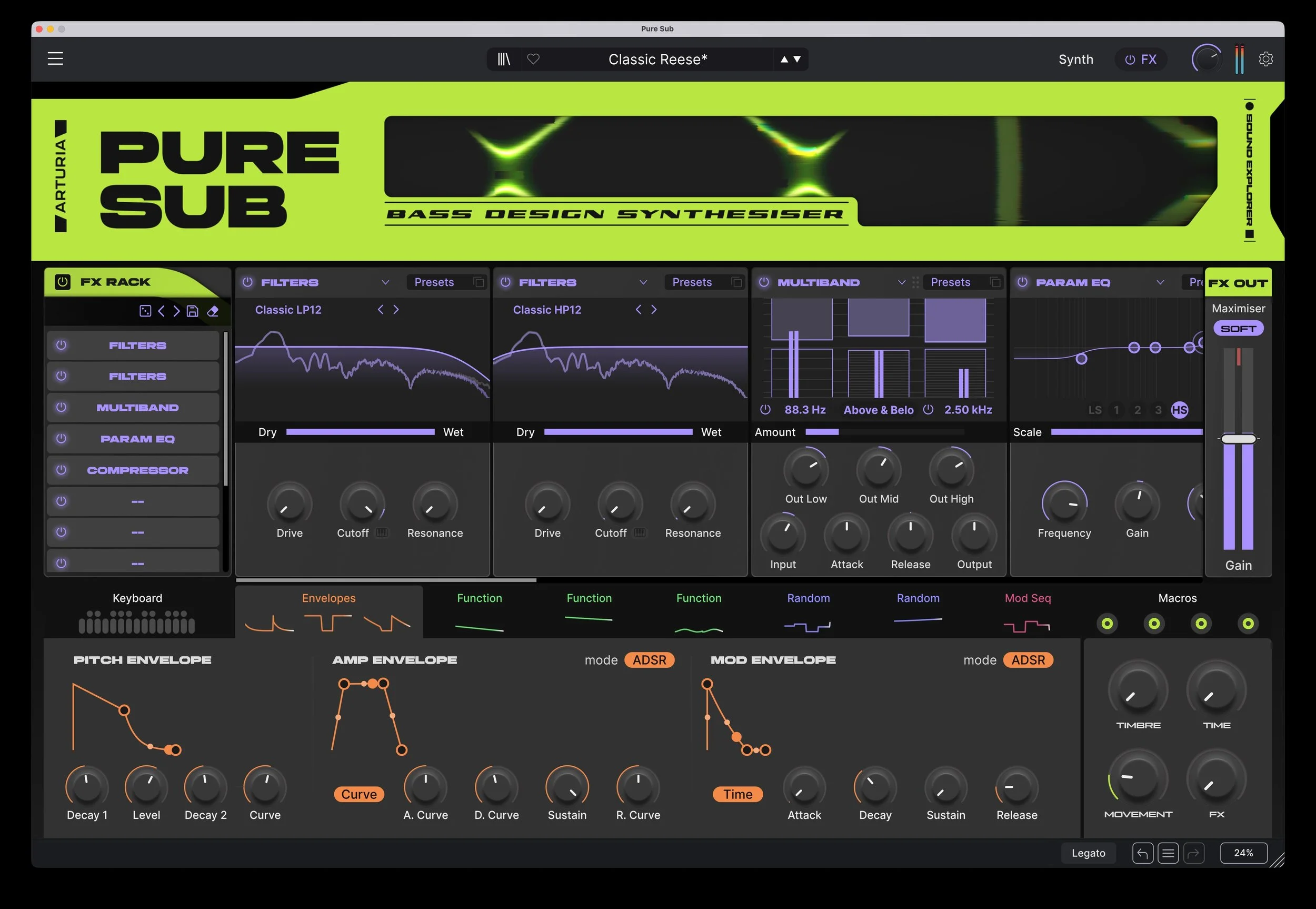
Controlled pitch movement. A dedicated Pitch Envelope shapes glides and transient punch while Sub Regen keeps that movement tied cleanly to a stable low end.
This Matters because the sub frequencies tend to disappear on speakers without a subwoofer — phones, laptop speakers, cheap earbuds. Getting a patch to translate usually means building harmonic content above the fundamental so the ear can still perceive "bass" even when the actual low frequency isn't reproduced. Pure SUB's Texture layer — key-tracked noise, AM, ring mod — exists to build that harmonic presence, while the Sub layer keeps the full-range punch intact on systems that can actually play it back.
That's the theory behind the architecture, at least; how well it holds up depends on the patch and the system, and it's the kind of thing that needs an actual A/B across a few playback devices to confirm rather than take on faith.
Hands-On Impressions
The preset library is genuinely strong — a lot of the 300 factory patches are immediately usable, and they're a good entry point into the plugin more broadly. Pure SUB is a powerful tool, but it's also a technical one: it's accessible in the sense that nothing is hidden too far behind sub-menus, but wrapping your head around how the pieces interact takes some time if you're not already used to programming synths, or at least this style of layered, sub-focused one.
The instrument rewards ear-led exploration, though — you'll get to a usable, personalized sound faster than the learning curve might suggest, and starting from a preset and tweaking it into your own patch is a much faster on-ramp than building from a blank slate. The effects section backs up its spec sheet, too: the FX are high quality across the board, and paired with the Sub Processor, this feels like a genuinely powerful instrument rather than a gimmick built around one feature.
Alternatives to Consider
Arturia Pigments
Pure SUB shares visual language with Pigments but isn't a stripped-down version of it. Pigments is a general-purpose, polyphonic engine built for wavetable, sample, and granular synthesis across the whole range. Pure SUB trades that openness for a fixed architecture built specifically to protect the fundamental during aggressive sound design — a genuinely different tool, not a subset.
FAW SubLab XL
The long-standing reference point for 808 and sub-bass work, built around sample layering and letting you blend your own kick samples directly into its sub engine. Compared to SubLab, Pure SUB leans harder into synthesis-driven design instead — custom harmonic shaping via the Pressure engine, flexible modulator slots (Function, Random, Envelope, Step Sequencer, Voice Modulator), and a considerably larger built-in FX rack.
Kilohearts Phase Plant
Near-limitless modular routing for producers who want to build custom split-band and cross-modulation networks from scratch. The tradeoff is setup time. Pure SUB gives up that openness for a guarded, purpose-built interface that gets you to a stable sub sound faster.
Spectrasonics Trilian
A sample library built for organic, multi-sampled realism across electric, acoustic, and classic hardware bass. Pure SUB is the opposite approach entirely: a synthesized, digitally native tool for modern sub-bass, 808 glides, and textures rather than recorded instrument character.
Verdict
Pure SUB is a focused, well-built answer to a real problem in modern music production: creating cutting-edge and inspiring bass sounds while keeping the low end intact under heavy processing. It's a new step in a line of exciting future-focused and innovative instruments for Arturia. Producers working in bass-heavy genres — from EDM to trap — will get a lot out of it.
Consider Pure SUB if you produce bass-heavy electronic music, regularly fight low-end translation issues, or want to design anything from 808s to Reese basses quickly without building parallel processing chains by hand every time.
Skip Pure SUB if you already have a dialed-in sub workflow in Phase Plant or Pigments, or you prefer building your split-band chains manually and don't need the guardrails.
Disclosure: This site contains affiliate links. If you purchase through these links, I may earn a commission at no extra cost to you.