
All Behringer Drum Machines, Ranked
Behringer’s drum machine lineup has become one of the most expansive and accessible rhythm collections available today. Drawing inspiration from legendary analog and early digital drum machines, these boxes cover a wide range of workflows — from hands-on pattern programming and classic club rhythms to vintage preset beats and modern sample-based production. This guide rounds up every current and announced Behringer drum machine, highlighting what each one does best and who it’s for. Whether you’re chasing 808-style punch, 909-inspired drive, Linn-style samples, or simple groove boxes for fast idea-making, this list is designed to help you quickly understand the strengths of each machine and choose the right tool for your setup.
Behringer RD-8 MkII
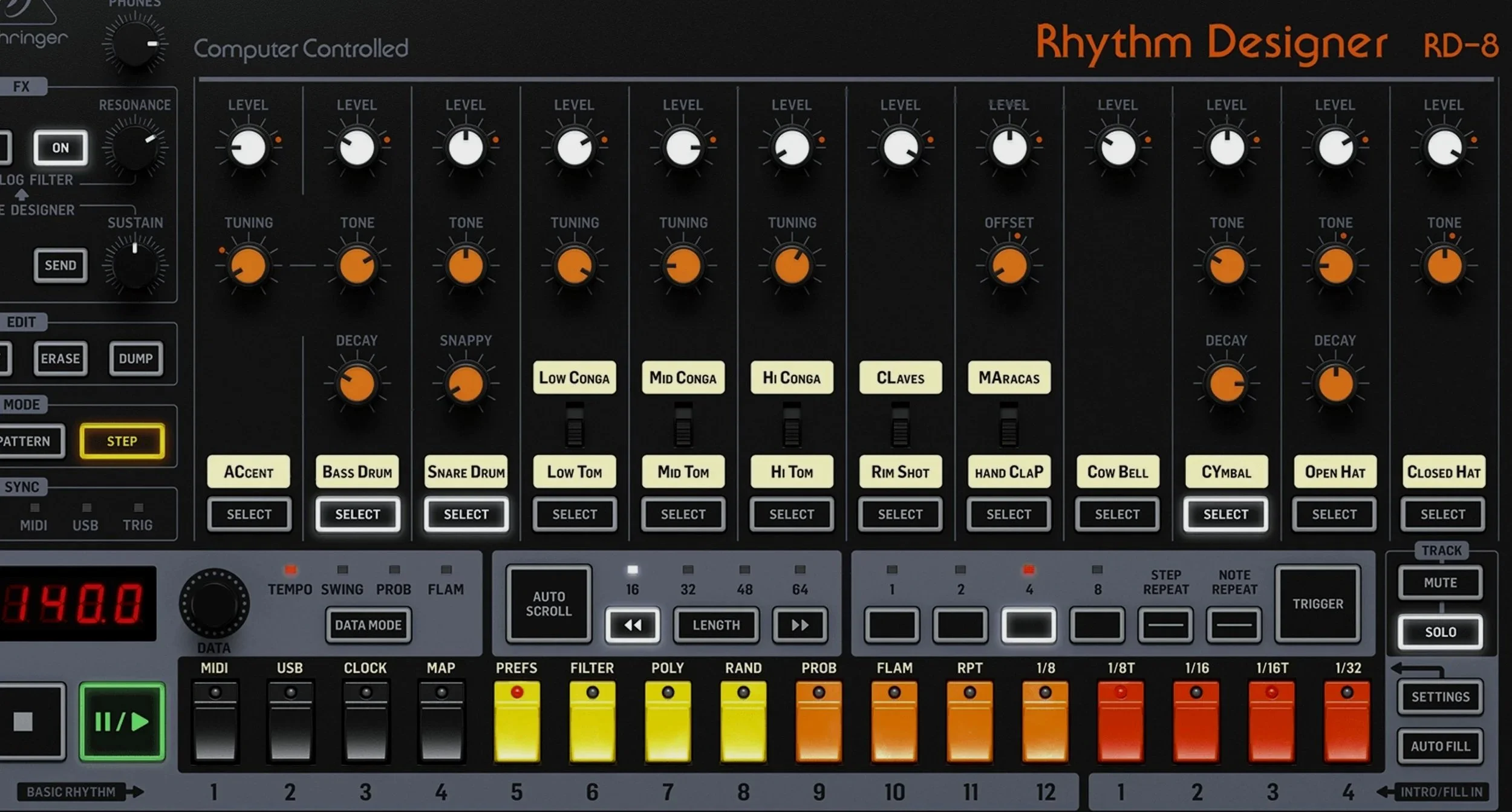
The RD-8 MkII sits at the center of Behringer’s drum machine lineup and is the most complete option if you want one box that can handle studio production, live performance, and hardware-heavy setups. It’s a fully analog rhythm machine inspired by the TR-808, but expanded with a modern sequencer, extensive hands-on controls, and deep connectivity. Each voice has dedicated controls, making it easy to sculpt kicks, snares, claps, and percussion without menu diving, while the step sequencer supports longer patterns, variations, and song-style arrangements.
What really elevates the RD-8 MkII is how well it integrates into real-world workflows. Individual outputs make it ideal for mixing on external consoles or processing with pedals and outboard gear, while MIDI, USB, and sync options keep it locked with DAWs, synths, and modular rigs. It works just as well as a central drum brain in a live setup as it does as a dedicated analog groove machine in the studio, which is why it’s often considered the strongest all-round drum machine Behringer currently offers.
Check price
Behringer RD-9
The RD-9 is Behringer’s take on the TR-909 formula, built for punchy, forward drums that sit naturally in house, techno, electro, and acid-oriented tracks. Its analog voice architecture delivers the tight kicks, snapping snares, crisp hats, and aggressive percussion that made the original a club staple, while the layout stays familiar and performance-focused. If you’ve ever programmed a 909-style machine, the RD-9 immediately feels intuitive, with clear step sequencing and dedicated controls for shaping each sound.
Where the RD-9 stands out is in how it balances authenticity with modern usability. The sequencer supports extended patterns, probability-style variations, and live performance tricks that go beyond vintage hardware, while connectivity options make it easy to integrate with DAWs, MIDI gear, and external processing. It’s less about experimental sound design and more about delivering reliable, driving rhythms that cut through a mix, making it a natural choice for producers who want classic club energy without chasing vintage hardware prices.
For producers working with modular or external drum voices, Behringer also offers the RS-9 Eurorack Rhythm Sequencer, a dedicated rhythm sequencer designed to drive drum synths and percussion modules. While it isn’t a sound source on its own, it can serve as an alternative sequencing brain for setups where the RD-9’s internal sequencer isn’t the center of the system.
Check price
Behringer LM Drum
The LM Drum takes a different approach from Behringer’s analog rhythm boxes, leaning into classic digital drum history instead. Inspired by the LinnDrum lineage, it’s built around sample playback rather than analog synthesis, making it a strong choice for producers who want punchy, recognizable drum tones with a more precise, studio-friendly character. The sound palette focuses on vintage digital drums, but with modern shaping tools that let you push those samples further than the originals ever allowed.
Beyond the sound engine, the LM Drum feels designed for structured pattern work and song building. Its step sequencer supports longer patterns and variations, making it easy to program full arrangements rather than short loops. It fits especially well in setups where drums need to sit cleanly alongside synths and vocals, or where sample-based consistency matters more than raw analog character. If you want a Behringer drum machine that bridges old-school digital drums with modern sequencing flexibility, this is the most distinctive option in the lineup.
Check price
Behringer RD-78
The RD-78 is Behringer’s nod to early rhythm boxes that prioritized immediacy over deep programming. Inspired by the Roland CR-78, it centers on classic preset patterns and unmistakably retro drum tones that feel right at home in synth-pop, disco, early electronic, and soundtrack-style productions. Rather than pushing detailed sound design, the RD-78 is about dialing in a vibe quickly and letting the rhythms do their thing.
What makes the RD-78 appealing today is how it reframes those old-school ideas in a modern context. You still get hands-on control and a straightforward interface, but with contemporary connectivity that allows it to slot into current studio and live setups without friction. It’s not a machine for tweaking every drum hit, but for producers who want character, nostalgia, and fast inspiration, it offers a very different rhythm experience from Behringer’s more programmable drum machines.
Check price
Behringer RD-6
The RD-6 is the most stripped-back drum machine in Behringer’s lineup, modeled after the TR-606 approach to fast, no-frills rhythm programming. It’s fully analog, compact, and designed around immediacy: pick a sound, place the steps, and you’ve got a groove in seconds. The drum voices are simple but characterful, with that dry, snappy feel that works especially well for techno, electro, and lo-fi styles where restraint is part of the sound.
What makes the RD-6 appealing isn’t depth, but focus. The limited feature set keeps you out of menus and encourages quick pattern writing rather than endless tweaking. It’s an easy fit for small setups, portable jams, or as a secondary drum machine that adds a contrasting texture alongside more complex gear. If you want an affordable hardware drum machine that gets out of the way and lets you sketch ideas fast, the RD-6 does exactly that.
Check price
Behringer SDS-3
The SDS-3 is a Simmons-inspired analog drum synthesizer built for shaping drum sounds from the ground up rather than programming traditional step patterns. Instead of relying on preset samples or fixed drum voices, it focuses on sound sculpting — letting you design kicks, toms, snares, and synthetic percussion using pitch, envelopes, noise, and tone controls. The result leans heavily into classic ‘80s electronic drum character, with plenty of room for experimental textures.
This machine makes the most sense for producers who want custom drum synthesis rather than a self-contained rhythm box. It’s designed to be triggered externally, whether from a hardware sequencer, DAW, or modular system, making it feel more like a dedicated drum voice module than a standalone groove machine. If your priority is crafting unique percussive sounds instead of programming full drum patterns in one box, the SDS-3 fills that niche better than Behringer’s traditional drum machines.
Check price
Behringer BDS-3
The BDS-3 is a four-voice analog drum synthesizer inspired by the classic Simmons SDS-3, designed to recreate that unmistakable ‘80s electronic drum sound. It specializes in punchy toms, sharp synthetic kicks, and distinctive metallic percussion, with dedicated controls for shaping pitch, decay, and tone on each voice. Compared to sample-based machines, its sound is more synthetic, exaggerated, and character-forward — perfect for retro, synthwave, EBM, and vintage-inspired electronic tracks.
Rather than functioning as a full drum machine with an internal sequencer, the BDS-3 is meant to be played and triggered externally, making it a great companion to hardware sequencers, DAWs, or modular rigs. It excels as a tone generator for producers who want bold, unmistakably electronic drums without relying on samples. If you’re chasing classic Simmons flavor with modern reliability and integration, the BDS-3 stands out as one of Behringer’s most characterful rhythm-focused tools.
Check price
Behringer Edge
The Edge is Behringer’s take on the Moog DFAM concept: a semi-modular analog percussion synth built for generating rhythmic patterns through synthesis rather than classic drum sequencing. Instead of loading preset drum sounds, it creates percussive hits using oscillators, filters, envelopes, and patchable routing, giving it a raw, organic, and often unpredictable feel. The onboard sequencer is more about driving evolving rhythmic motion than programming conventional drum beats.
What makes the Edge compelling is its hands-on, exploratory workflow. With patch points for rerouting signals, it encourages experimentation — from tight, punchy percussion to wild, modular-style rhythmic chaos. It can function as a standalone rhythmic voice or as part of a larger modular or hardware setup, making it ideal for producers who want percussion that feels alive, imperfect, and deeply tweakable rather than locked into traditional drum machine structures.
Check price
Behringer BMX — Upcoming DMX-style drum machine (announced)
The BMX is an upcoming Behringer drum machine inspired by the classic Oberheim DMX, shown publicly but not yet released. Like the original, it’s positioned around sample-based drums with a distinctly punchy, early-digital character that sits somewhere between vintage hip-hop, electro, and early club music. From what’s been demonstrated so far, the BMX is clearly aimed at producers who want that authoritative DMX-style sound without relying on samples in a DAW or tracking down rare hardware.
In Behringer’s lineup, the BMX looks set to fill the gap between the LM Drum and the RD-9. Where the LM Drum leans into Linn-style flexibility and the RD-9 focuses on analog club impact, the BMX brings a more rigid, iconic digital drum identity built around classic patterns and hits. While final specs and workflow details haven’t been confirmed yet, its announcement signals Behringer’s continued expansion into historically important drum machines — and makes the BMX one of the more interesting rhythm releases to watch in the near future.
Check price
Behringer has announced many upcoming products, most of them heavily inspired by some of the holy grails of synthesizer history.
If you’d like to learn the latest details, click here to check our post on the topic.
Disclosure: This site contains affiliate links. If you purchase through these links, I may earn a commission at no extra cost to you.