
The Best Behringer Mini Synths: Tiny Machines, Big Sound
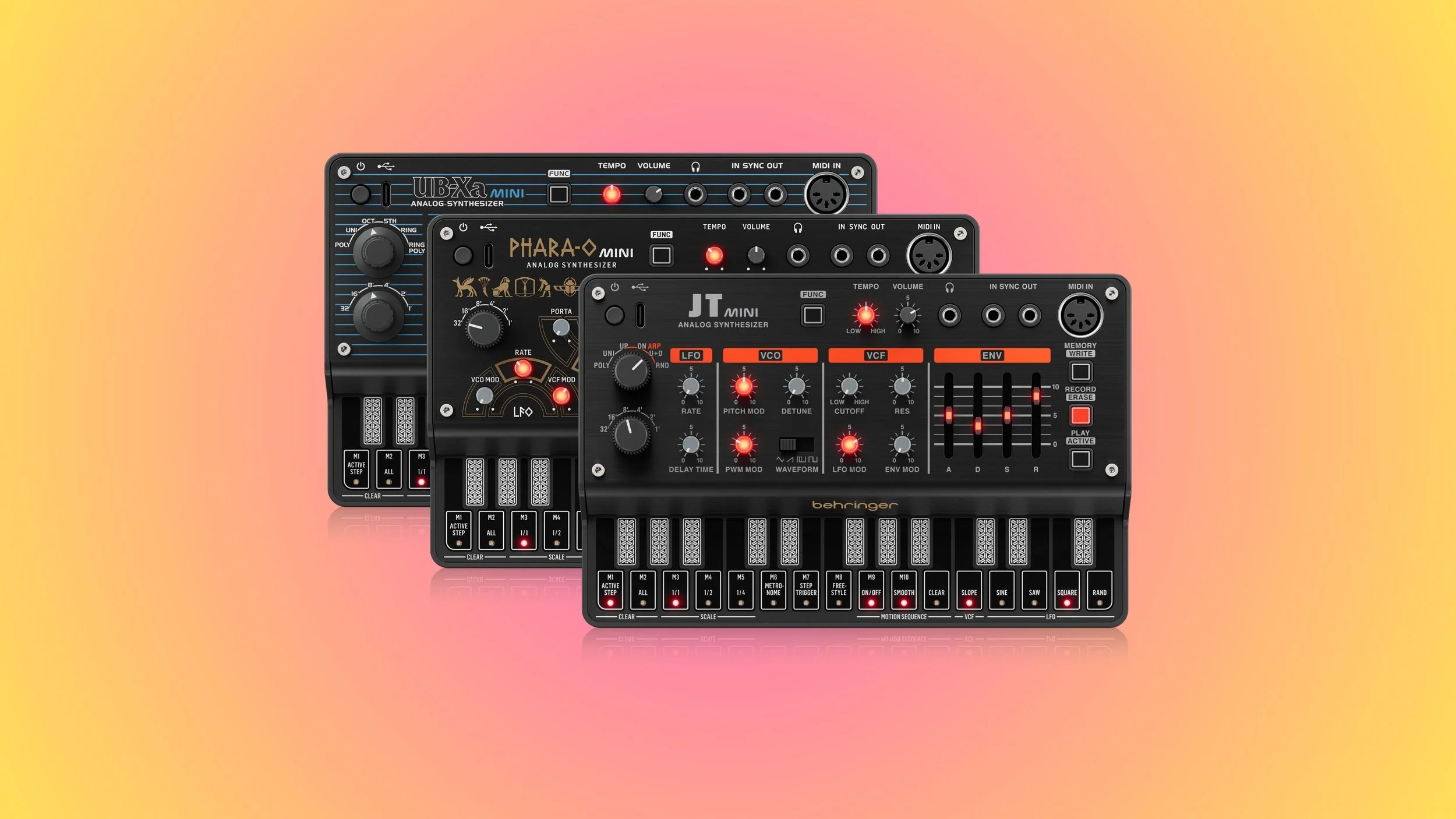
Hardware synths are having this funny second life right now. Not the giant flagships or modular spaceship rigs — but the tiny, affordable boxes that can sit on your desk next and take about as much real estate as your mug of coffee. Behringer’s Mini and Micro lineup feels like the company finally acknowledging what so many people actually want: compact instruments that sound inspiring, produce sounds on the go, and don’t cost a month’s rent. These things are for sketching ideas, jamming on the couch, building a portable setup, or just filling your tracks with character the moment you plug them in. What’s cool about this line is that it isn’t a gimmick. You’re getting classic synthesis DNA — vector wavetable tricks, Jupiter-style pads, vintage poly architecture, phase-distortion weirdness — all shrunk into something you could literally run off a USB power bank. They aren’t presets-and-go tablets, and they’re not trying to be “all-in-one everything” machines. They’re vibe machines. Small, slightly eccentric, incredibly fun vibe machines. Whether you’re a beginner dipping into hardware or a producer who likes to noodle between render bounces, these Minis make it hard not to reach for hardware every day.
Disclosure: This site contains affiliate links. If you purchase through these links, I may earn a commission at no extra cost to you.
Pro VS Mini — The Pocket Vector Synth With Real Depth
The Pro VS Mini is what happens when a legendary vector synth idea gets shrunk into a palm-sized modern box. You get four digital oscillators you can morph between in real time — think glassy pads, metallic sweeps, digital choirs, eerie movement, and rave-ready stabs. There’s something cinematic and emotional here, but also playful: twist a few parameters and it slides straight into crunchy IDM textures or shimmering ambient beds. It encourages exploring tone rather than dialing in a fixed “correct” patch, and that’s where it shines. It feels like a sketchbook for sound design, not just another mono bass toy.
The biggest surprise is how musical it is. You can sequence melodies, modulate the morphing with motion recording, and carve out evolving tones without getting lost in menus. If you like synths that breathe and shift — like the Prophet VS, Wavestation, or modern wavetable plugins — this is the mini that gives you that dimension-shifting magic in a pocket form. Perfect for downtempo, synth-pop, film scoring experiments, or nighttime headphone jams where you just want to drift.
Check price
JT Mini — Portable Jupiter Flavor With a Warm, Liquid Tone
The JT Mini is Behringer’s small-format take on classic Jupiter-style synthesis, and it brings that lush, liquid character into a surprisingly friendly, portable package. It’s three-voice paraphonic, so you can play chords or stacked leads, and the oscillators glide in this slightly syrupy way that just feels musical. Pads bloom with a softness that avoids the sterile thing cheaper polys often fall into, and basses have that round, rubbery punch that instantly brings to mind early house and synth-pop. Even if you’re not trying to recreate vintage Roland tracks, there's something timeless and optimistic in the tone — like it wants to soundtrack sunrises and neon reflections rather than industrial chaos.
Where the JT Mini really lands is immediacy. You don't need to fight it to get something pretty or emotional going; the filter is smooth, the modulation is just enough to stay playful, and the sequencer gives you a quick way to generate ideas without opening a DAW. It's not trying to be a deep programming workstation — it’s about inspiring moments. Pair it with a simple delay plugin or a hardware pedal, and suddenly you’re in dreamy soundtrack land. For anyone who's always wanted “that” poly sound without committing to a full-size synth, this little box scratches the itch beautifully.
Check price
Phara-O Mini — Analog Grit With a Sequencer That Wants To Move
The Phara-O Mini is where the Mini lineup goes from dreamy and textural to gritty and physical. It’s a three-voice analog synth with a built-in sequencer, and there's a real swagger to the way this thing shapes basslines and squelchy leads. The oscillators feel alive in that slightly unruly way — buzzy harmonics, warm drift, and this punch that borders on aggressive when you push the filter. If the JT Mini feels like synth-pop romance, the Phara-O Mini feels like warehouse-smoke techno and jagged acid lines written on a kitchen table at 2 a.m. It’s an immediate vibe machine with a little chaos in its blood.
The sequencer is the secret sauce here. It isn’t trying to be a DAW replacement, but it’s fast, fun, and built for movement — pattern tweaking, little rhythmic nudges, melodic stabs that turn into hypnotic loops. It’s the kind of machine that invites you to tap in a bassline, ride the filter, and disappear into a groove. If your music leans toward electro, EBM, minimal, acid, or anything with pulse and teeth, this might be the most inspiring pick in the lineup. It's also a sleeper sketch tool for modular-curious producers — the workflow teaches you how to think in sequences and motion rather than chords and pads.
Check price
JT-4000 Micro — Tiny Digital Engine With Surprising Range
The JT-4000 Micro is the most “how is this even real?” entry in the lineup. It looks almost like a toy at first glance — ultra-compact, touch buttons instead of full keys, USB-powered minimalism — but once you start twisting parameters, you realize it’s hiding a genuinely expressive synth engine. The digital oscillators have a bite and shimmer you don't expect in this price/size bracket, and you can carve anything from glassy pads to chiptune-bright leads to rubbery basslines. There’s a slightly raw, early-digital charm to it — like the sound of late-80s Roland workstation DNA filtered through a modern pocket synth brain.
It’s definitely a “sit on your desk and noodle” instrument, but it also weirdly holds its own as a travel synth or couch-jam companion. Don’t come here expecting massive interface depth — it’s about immediacy and portability. But if you treat it like a sound-sketch tool or melodic idea starter, it’s borderline addictive. Plug it into effects (even a simple reverb and chorus chain) and suddenly it feels like a lost digital synth module from the golden-era hardware world. For producers who love ambient, retro game motifs, or experimental electro textures, the charm-to-cost ratio is kind of ridiculous.
Check price
CZ-1 Mini — Phase-Distortion Sparkle With Retro-Digital Soul
The CZ-1 Mini brings that unmistakable phase-distortion sound into a tiny, modern box — and it feels like rediscovering a forgotten branch of synthesis history. Instead of trying to imitate analog warmth, it leans proudly into its digital DNA: bell tones with crystalline edges, animated plucks that feel like vintage video-game soundtracks gone cinematic, and evolving pads that shimmer rather than smear. It can sound pretty and glassy one minute, rubbery and punchy the next, then drift into weird noise-art territory if you push the modulation. This thing really rewards curiosity — it’s the Mini to grab if your musical world includes vaporwave textures, IDM experiments, ambient dreamscapes, or early-rave sparkle.
What makes the CZ-1 Mini fun is how immediate it feels for a digital synth. It’s not buried in menus; you twist knobs, record motion, and suddenly you’re sculpting these shifting, pixel-fantasy tones that feel different from anything in the rest of the Mini lineup. Add a bit of chorus and reverb and it becomes unexpectedly lush; run it dry and you get that crisp, glass-pane FM-adjacent snap. It might not be the first pick for big bass or warm pads — but if you’re drawn to sound design, texture, and mood, this is a tiny box with a big identity.
Check price
UB-Xa Mini — Oberheim-Style Warmth in a Compact Format
The UB-Xa Mini brings that big, classic Oberheim-style tone into a format you can toss in a backpack — and it’s honestly kind of wild how close the vibe gets. The oscillators have that rich, velvety thickness you expect, the filter sweep feels warm rather than aggressive, and pads have this emotional, widescreen quality that instantly suggests synth-pop nostalgia and cinematic romance. It isn’t trying to be a powerhouse workstation — it’s more like a concentrated bottle of analog tone. Fire it up, dial a pad, add a hint of chorus, and you’re suddenly in Drive soundtrack territory. Leads feel smooth and expensive, and even simple bass patches carry that classy analog weight.
Part of the charm here is how hands-on and immediate it is. You’re not diving through pages — you’re playing, twisting, recording motion, and shaping atmosphere. The paraphonic architecture gives it a slightly raw character when playing chords, but in a way that feels musical rather than limiting; it has personality. For producers who love lush pads, emotional leads, and warm analog beds — and want it in a portable, desk-friendly box — the UB-Xa Mini delivers classic character without needing a dedicated shrine in your studio.
Check price
The Next Step: Budget Behringer Synths Worth Considering
Once you’ve played around with Behringer’s Mini lineup and start craving something a little deeper, there’s a sweet middle tier worth knowing about. These aren’t huge keyboards or wallet-destroyers — they’re still affordable entry-level synths — but they give you more control, fatter tone, and a workflow that feels closer to classic analog gear. Think of them as the natural “level two” after the Minis: still tiny-desk and backpack-friendly, but way more capable. Models like the Model D, K-2, and TD-3 are perfect examples. They aren’t pocketable, but they stay under the same vibe — simple, direct, hands-on, and fun — just with a little more sonic muscle and real synth depth.
The Model D gives you thick, iconic mono synth power with three oscillators and a ladder filter — still cheap, still compact, still one of the best analog deals in hardware. The K-2 nudges you toward modular thinking with patch points and semi-modular architecture, meaning you can learn synthesis more seriously without diving into Eurorack chaos yet. And if basslines and sequenced patterns are your world, the TD-3 is the small-setup staple: playful, gritty, and perfect for house, acid, and DIY techno rigs. None of these sacrifice portability or price — they’re just the slightly bigger siblings that show you what hardware can do once you're ready to move past the “toy-sized but magic” phase.
Check the full Behringer synth lineup here
Final Thoughts
Behringer’s Mini lineup hits a really fun sweet spot: genuinely musical, genuinely affordable, and small enough to live on your desk without turning your life into a cable swamp. They’re not pretending to be flagship synths — and that’s the magic. They’re idea machines. Couch-friendly, battery-sip-compatible, quick-to-jam tools that lower the barrier between you and sound. If you’re new to hardware or just want something to spark ideas outside the DAW, these little boxes absolutely hold up.
And as you dive in, it’s nice to know there’s a natural upgrade path that keeps the same spirit — compact, budget-friendly, no-nonsense — but gives you deeper synthesis and performance chops when you’re ready. Whether you stick to the Minis or eventually move toward modules like the Model D or TD-3, the point is the same: this is music hardware that encourages play. No menu diving, no overthinking, just hands, ears, and ideas. In a world overflowing with complex tools, there’s something refreshing about that simplicity.
Disclosure: This site contains affiliate links. If you purchase through these links, I may earn a commission at no extra cost to you.