
Native Instruments Resurrects Absynth 6: A Cult Synth Returns With Modern Upgrades

When Native Instruments retired Absynth a few years ago, the reaction wasn’t mild disappointment — it was grief. For producers and sound designers, Absynth wasn’t just another soft synth; it was an engine for evolving atmospheres, impossible textures, and the kind of strange, shifting tones that defined entire eras of cinematic and electronic sound. After years of absence, the synth is back as Absynth 6, rebuilt for modern systems with a sharper interface, deeper modulation, and the expressive tools today’s workflows expect. What makes this revival meaningful isn’t nostalgia — it’s intent. NI didn’t simply repackage Absynth; they rebuilt it in collaboration with its original creator, Brian Clevinger, preserving the soul of the instrument while rethinking how it should behave in the modern era. The result is a synth that still leans into the weird, organic, semi-modular identity that made it iconic, but now feels faster, clearer, and more playable. For anyone working in ambient, cinematic scoring, experimental electronics, or textural sound design, the return of Absynth is a moment.
Want to hear what Absynth 6 can really do? Check the official demos here
The Absynth Legacy: How We Got to Version 6
For nearly two decades, Absynth was one of the most distinctive instruments in Native Instruments’ lineup — it didn’t chase analog nostalgia or conventional synthesis, but it instead carved out a language of sound that felt almost alien. When it debuted in the early 2000s, producers had never seen anything quite like its hybrid semi-modular architecture, its animated envelopes, or its ability to morph between synthesis methods in a way that felt fluid. Film composers used it for its eerie, evolving atmospheres; electronic musicians used it to push past familiar timbres; and sound designers treated it as a portal into textures that didn’t exist anywhere else. As other synths modernized around it, Absynth remained uniquely itself — esoteric, deep, and adored by the people who understood its power.
That’s why its discontinuation in 2022 hit so hard. For many, Absynth wasn’t obsolete — it was unfinished business. But resurrecting it wasn’t a matter of flipping a switch. The original codebase needed a full rebuild to run comfortably on today’s systems, and the challenge wasn’t just technical: it was philosophical. Absynth had to evolve without losing what made it irreplaceable. Working once again with creator Brian Clevinger, NI approached Absynth 6 as both restoration and reinvention. The result preserves the instrument’s DNA — the hybrid engine, the evolving modulation, the unmistakable sonic attitude — but finally places it in a contemporary context. This isn’t Absynth preserved in amber. It’s Absynth given a second life.
What’s New in Absynth 6: Features, Engine, and Creative Potential
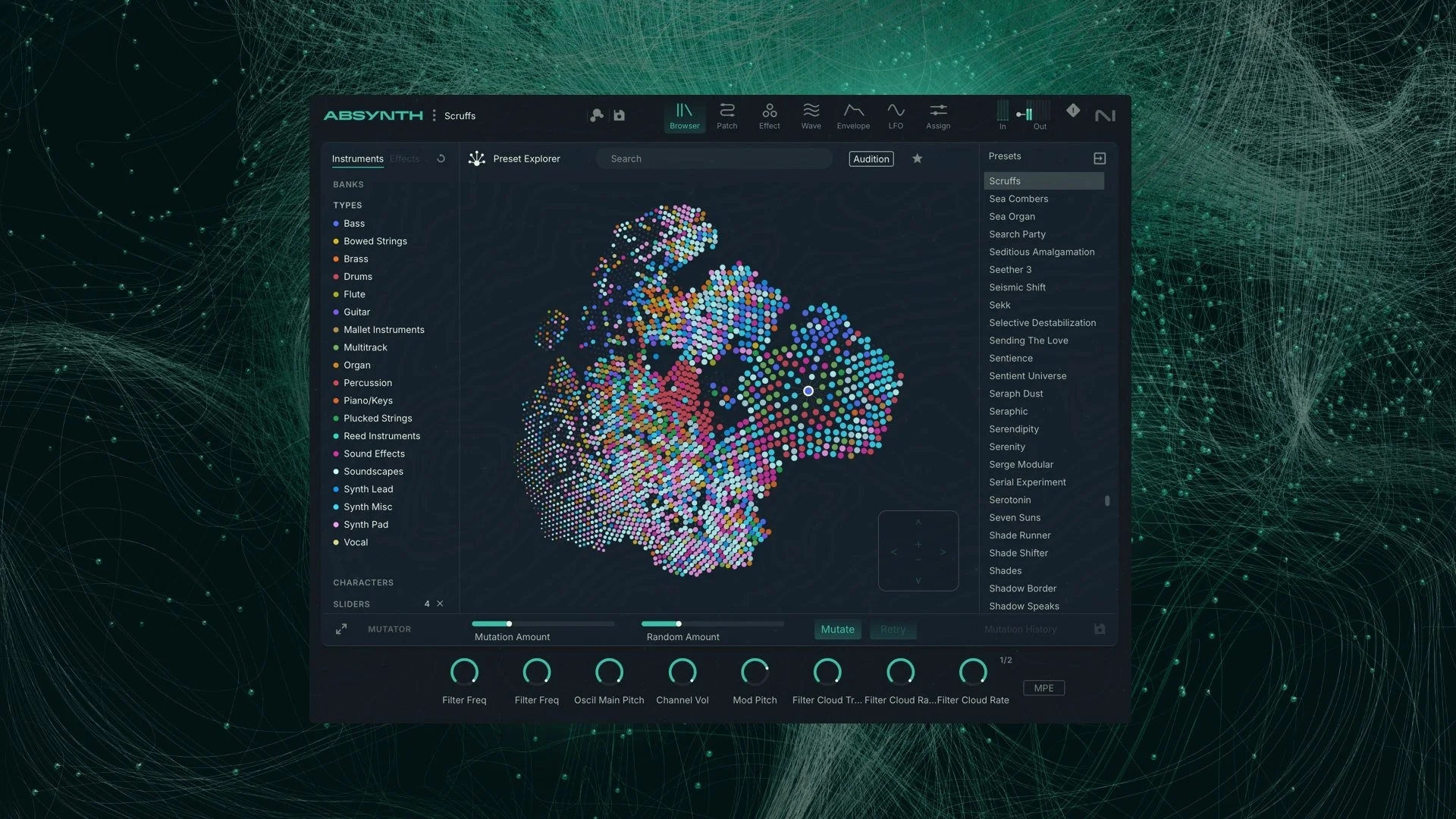
Absynth 6 doesn’t try to reinvent the synth so much as refine and modernize the things that always made it singular. The hybrid semi-modular engine is still the heart of the instrument, but almost every part of it has been reworked to feel sharper and more fluid in a modern environment. Oscillators respond more cleanly, filters behave with greater stability, and modulation now feels more immediate thanks to a rebuilt architecture that supports MPE and polyphonic aftertouch. The signature 68-point envelopes have also been expanded and are easier to shape, letting you create those evolving, animated movements that defined earlier versions of Absynth but with far less friction. And while the synth remains deep, the redesigned interface finally gives it a visual clarity the older versions never quite had — editing is more readable, signal flow is easier to follow, and the instrument feels less like an intimidating artifact and more like a deliberately crafted sound-design tool.
Just as important as the engine updates is the way Absynth 6 handles exploration. The new Preset Explorer replaces the old hierarchical list with a visual, AI-assisted browser that groups sounds by character and function rather than by name. This subtle shift drastically changes how new users interact with the instrument: instead of hunting through folders, you lean into sonic discovery. Legacy patches load natively, and the library now merges classic material with hundreds of new sounds built specifically for the updated engine, giving the instrument a broader, more polished palette.
Surround and multichannel support also bring Absynth into workflows where atmospheric depth is essential, whether that means film scoring or immersive electronic music. Everything about Absynth 6 suggests a synth rebuilt for the way people design sound today — not simplified, but clearer, faster, and more expressive.

Sound, Workflow, and Real-World Use
Absynth has always been defined by in part by its ability to create atmospheres — that unmistakable blend of evolving pads, shifting tonal movement, and textures that feel alive rather than constructed. Absynth 6 preserves that character but gives it more dimensionality and nuance, partly due to the refinements in its oscillators and modulation engine. The hybrid nature of the synth still allows you to fuse FM grit with wavetable motion, blend subtractive warmth with granular-style shimmer, or sculpt organic drones that seem to breathe and expand over time. What stands out now is the clarity: sounds feel deeper and more stable, especially when animated through long envelope curves or complex modulation paths. Whether you're designing cinematic beds, experimental electronic gestures, or subtle transitions that need to evolve over minutes, Absynth 6 still feels like the instrument that can go where others don’t even try.
The workflow updates have just as much impact as the sonic improvements. Editing no longer feels like spelunking through dense pages of parameters; instead, the redesigned layout and cleaner navigation make the synth feel unusually inviting for something this deep. The Mutator remains one of the fastest ways to generate fresh variations from existing patches, and it now behaves more predictably thanks to engine-wide tuning.
The new Preset Explorer shortens the gap between inspiration and execution, letting you land on the right starting point without scrolling through endless lists. And with the addition of MPE and polyphonic aftertouch, Absynth finally becomes a truly expressive performance instrument — something earlier versions hinted at but never fully delivered. For producers using modern controllers, the synth now responds dynamically to touch, pressure, and articulation, turning its evolving textures into something tactile rather than purely programmed.
Alternatives: What Are Other Synths in the Hybrid Space?
Absynth has never had a perfect one-to-one competitor, but there are a few instruments that appeal to the same type of producer — people who want movement, depth, and a sense of sonic world-building. Arturia Pigments is the most obvious comparison because it also merges multiple synthesis engines and offers deep modulation, but its philosophy is much more visual and structured. Pigments excels at clarity and workflow speed, while Absynth leans into mood, abstraction, and those long, animated gestures that don’t feel bound to a grid.
Spectrasonics Omnisphere also enters the conversation, especially for composers, due to its massive library and hybrid engine. But Omnisphere’s strength is breadth and preset polish, whereas Absynth thrives in the strange edges of synthesis — zones where tones drift, mutate, or behave unpredictably in ways that feel almost organic.
On the more technical end, Kilohearts Phase Plant offers modular flexibility that lets you build sounds from first principles. It delivers a sleek modern engine for clean, precise sound design, but has a different vibe than NI’s plugin.
What Absynth 6 does better than any of these alternatives is deliver a sense of internal life — a sound that shifts with intention, responds to expressive input, and rewards long, slow modulation. In a world full of do-everything synths, Absynth remains the one that feels most like a living system.
Final Thoughts: Who Absynth 6 Is For?
Absynth 6 is unmistakably aimed at producers and composers who value atmosphere as much as melody — people who shape space, tension, and texture as part of their musical identity. If you work in ambient or experimental electronic music, the instrument feels almost purpose-built; it rewards slow evolution, nonlinear thinking, and sound design that unfolds over time.
Film and game composers will immediately recognize its utility for drones, transitions, and emotional undercurrents, especially now that surround support and enhanced modulation are baked into the workflow. Even electronic producers making more structured genres can take advantage of its ability to generate unusual pads, spectral leads, or subtly morphing backgrounds that don’t sound recycled from more common synth engines.
The return of Absynth is a reminder that software instruments can still feel mysterious and emotionally charged. Version 6 preserves everything that made Absynth iconic but finally places it in a modern creative ecosystem where expressive controllers, immersive audio, and faster workflows are the norm.
Disclosure: This site contains affiliate links. If you purchase through these links, I may earn a commission at no extra cost to you.