
The Best Chord Generator Hardware Synths, MIDI Tools & Plugins Right Now
Chord-focused tools and instruments are having a moment. As more producers look for ways to break out of the piano-roll mindset, dedicated chord generators — from quirky handheld devices to fully featured performance synths — are becoming essential creative companions. They take harmony out of the computer and put it into your hands, turning chord progressions into something tactile, performable, and instinctive. Whether you’re a trained musician or someone who never learned traditional voicings, these tools make it easy to explore richer harmonies, discover unexpected progressions, and spark ideas you wouldn’t find by dragging blocks in a DAW. This post focuses specifically on the hardware side of that movement: standalone chord-generating synths, physical MIDI chord controllers, and devices built from the ground up for harmony exploration. These aren’t just keyboards with a “chord mode” tacked on — they’re instruments designed to make chord creation feel expressive, immediate, and fun. Some behave like mini composition engines. Others lean into strumming, generative harmony, or tactile performance. And many of them pair beautifully with software tools for a hybrid workflow. If you’re looking for new ways to write progressions, perform harmonically rich lines, or simply escape the constraints of traditional playing, these are the hardware chord instruments worth knowing.
Suzuki Omnichord OM-108 Reissue
The Suzuki Omnichord OM-108 revives one of the most iconic chord-generating instruments ever made, offering a modernized version of the classic strumplate-and-chord-button workflow. It gives you instant access to major, minor, seventh, and other essential chord types, all arranged in an intuitive button system that anyone can play without musical training. Paired with the expressive touch-sensitive “strumplate,” the OM-108 turns simple gestures into harp-like glides, twinkling arpeggios, and dreamy pads that feel instantly nostalgic. It is deliberately simple, but that simplicity is what makes it such an inspiring songwriting tool.
Producers reach for the OM-108 when they want ideas to flow without getting pulled into theory or menu-diving. It works beautifully for sketching chord progressions, adding shimmery textures, or injecting that unmistakable Omnichord charm into electronic, indie, or ambient tracks. Its limitation is obvious — it’s not a sound-design machine, and its tonal palette is intentionally narrow — but its emotional fingerprint is so recognizable that it rarely feels like a drawback. For creators who value immediacy and vibe over depth, the OM-108 is one of the most characterful chord generators on the market.
For a cheaper, open-source alternative, there’s also the Minichord. This tiny 3D-printed synth offers a lot of the charm of the OM-108, but at a fraction of the price. And if you know your way around a soldering gun, you can even make you own!
Check price here
Teenage Engineering PO-20 Arcade
The PO-20 Arcade isn’t a chord generator on paper, but its sequencer, scale modes, and stacked-note tricks make it surprisingly good at creating chiptune-style harmonies. It’s built around 8-bit sound generation and rhythmic pattern-building, giving you tools to create bright, crunchy pseudo-chords, counter-melodies, and harmonic bursts that cut through any mix. Despite its ultra-tiny form factor, the PO-20 is incredibly musical and lends itself to rapid idea creation without getting bogged down in options.
In practice, artists use the PO-20 for quick harmonic sketches, layering chord-like motifs into beats, or adding retro character to modern electronic tracks. Its limitations are clear — it can’t generate lush pads or wide-spread voicings — but within its lane, it excels. The simplicity invites experimentation, and the signature TE aesthetic gives everything you play a playful, energetic vibe. If your chord needs lean more toward 8-bit sparkle than full harmonic depth, the PO-20 delivers exactly that.
Check price here
Telepathic Instruments Orchid
The Telepathic Instruments Orchid approaches chords from a totally different angle, blending algorithmic harmony with a responsive, performer-friendly interface. Instead of selecting predetermined chord types, you explore harmonies by interacting with knobs, sliders, and performance gestures that shape voicings in real time. Orchid uses generative logic to create chords that sit between predictable theory and expressive chance, making it feel less like a preset machine and more like an improvisational partner. Its tone engine reinforces that personality, producing lush, evolving harmonies that shift fluidly as you play.
Musicians lean on Orchid when they want chord ideas that feel organic, emotional, or slightly unexpected. It’s excellent for ambient producers, experimental artists, and anyone who thrives on inspiration through discovery. The tradeoff is that you don’t always get perfect theoretical accuracy — Orchid occasionally gives you chords you wouldn’t have chosen — but that unpredictability is a feature, not a flaw. Used as a sketchpad, a live performance instrument, or a MIDI generator feeding a larger setup, Orchid is one of the most creative chord tools available in hardware.
Check price here
AlphaTheta ChordCat
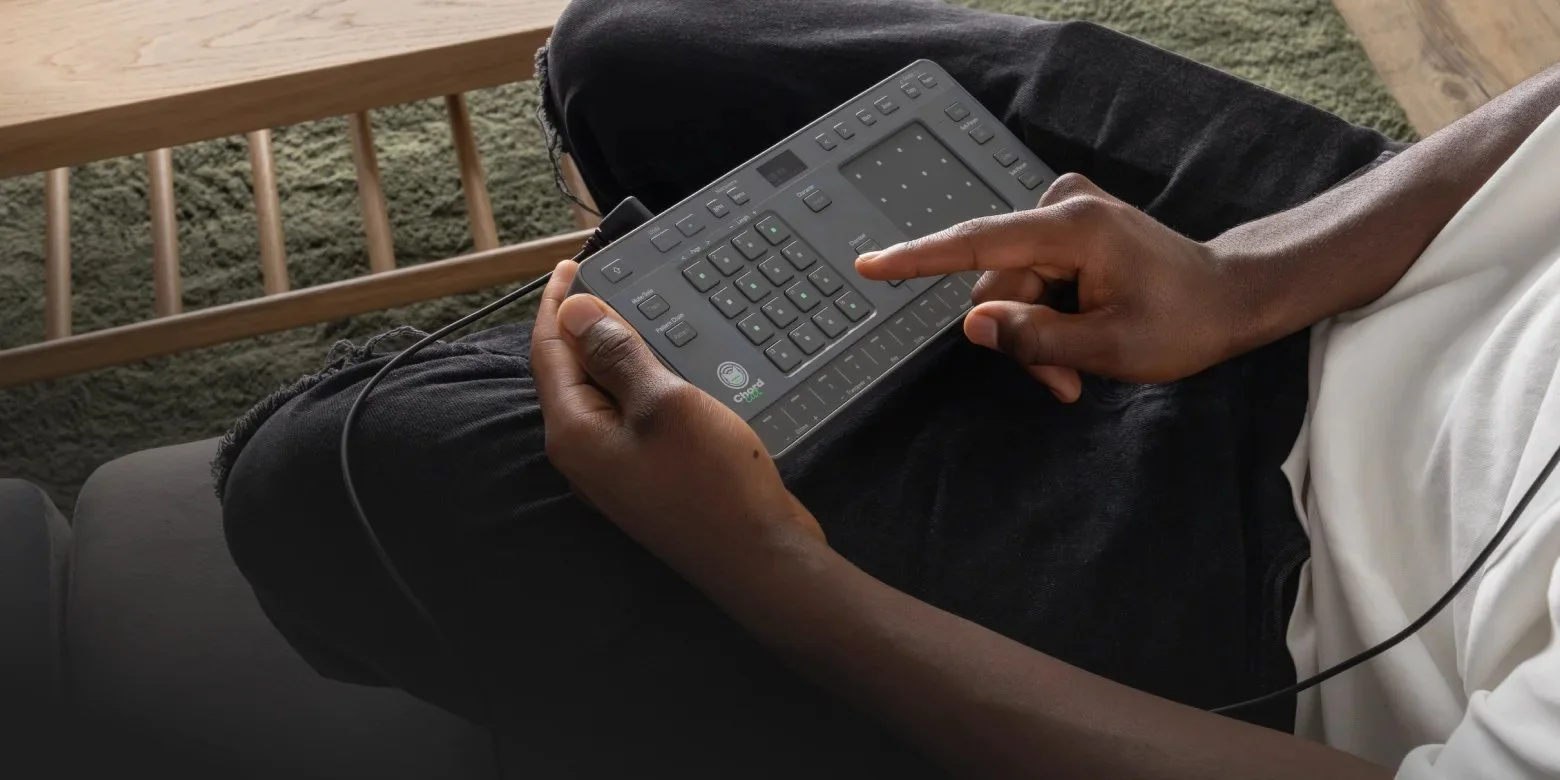
The AlphaTheta ChordCat brings a performance-oriented approach to chord generation, designed especially with DJs and electronic musicians in mind. It features dedicated chord pads, scale-locking, and real-time voicing controls that let you trigger harmonically rich stabs and progressions with very little setup. Unlike more traditional chord generators, ChordCat feels like a stage-ready controller from the moment you touch it, blending the immediacy of a sampler pad layout with the harmonic flexibility of a small polyphonic instrument.
In real-world use, ChordCat is fantastic for live sets, jam sessions, and hybrid DJ/producer performances. Artists rely on it to build chord hits, melodic hooks, or rhythmic harmonic patterns that stay locked to key while still offering expressive control. It’s not the choice for deep synthesis or customizable voicings, but it isn’t trying to be. Instead, it excels at giving performers the ability to add chords on the fly in a way that feels musical, quick, and tightly integrated into a modern electronic setup.
Check price here
Pocket Audio HiChord
The HiChord is a compact, handheld chord instrument that makes harmony feel playful and immediate. Its grid-based layout maps full chords to small physical buttons, turning simple one-finger presses into ready-to-use voicings. Despite its minimalist design and toy-like footprint, HiChord outputs full, warm, musical chords that work surprisingly well in pop, bedroom-production, and electronic settings. It’s the kind of device you can pick up with zero preparation and still walk away with real musical ideas.
Producers often use HiChord as a fast progression generator or as a portable MIDI brain for larger synths. Because it gives you instant access to extended voicings without requiring theory knowledge, it’s a great fit for workflows that prioritize speed, vibe, and experimentation. The limitation is that its sound engine is intentionally basic — it shines more as a controller than a standalone synth — but that design choice makes it feel focused and easy to incorporate into any setup. If you want a chord tool that never slows you down, HiChord nails that purpose.
Check price here
Roland AIRA Compact J-6
The Roland J-6 combines a chord generator, a JUNO-inspired synth engine, and a full pattern sequencer inside a pocket-sized device. Its chord modes let you trigger everything from simple triads to lush extended voicings, and Roland’s ACB modeling gives the sound engine a recognizable JUNO-style character. The interface is tight and purposeful: choose a chord set, press a button, and instantly hear polished harmonies that are ready for songwriting or performance. It sits comfortably between a portable idea machine and a legitimate mini-synth.
Producers gravitate toward the J-6 for quick composition, layering JUNO pads, or building sequenced chord progressions that groove. The sequencer becomes a creative engine of its own, letting you transform a single chord into arpeggios, riffs, or rhythmic pulses. While the tiny controls limit deep programming, they keep the workflow fast and fun. For anyone who wants a chord generator with real synth tone and a built-in songwriting workflow, the J-6 is one of the strongest ultra-portable choices.
Check price here
Ableton Push 3
Push 3 stands apart from the rest because it’s both a chord generator and a full production workstation. With its MPE-enabled pads, scale modes, built-in chord shapes, and the expressive depth of aftertouch and pitch control, it behaves more like a futuristic stringed instrument than a standard grid controller. Since it runs Ableton Live internally, every chord you play can be recorded, looped, and transformed directly on the device — no laptop required. The result is an instrument that goes far beyond triggering chords and becomes a complete composition environment.
Producers use Push 3 as both a performance surface and a standalone songwriting hub. It excels at building progressions, painting harmonic textures, or improvising expressive chord voicings that would be difficult on a traditional keyboard. It’s admittedly overkill if you only want a simple chord tool, but for musicians who want sound design, sequencing, harmony exploration, and full production in one box, there’s nothing else like it. Push 3 fills the role of a chord generator almost incidentally — and it’s one of the best at it.
Check price here
MIDI Chord Controllers & Tools
Other than the Ableton Push, there are other MIDI chord controllers fill the space between full instruments and software tools, giving you hands-on access to harmony without needing a dedicated sound engine. The Isla Instruments KordBot remains the gold standard here — a true chord workstation with voicing presets, strum modes, and progression memory that make it feel like a self-contained harmonic brain. In a different lane, the Knobula Chord Pilot brings chord control into Eurorack, letting modular users generate full MIDI chords with tactile, CV-reactive control. For players who want more expression, the Artiphon Chorda offers a hybrid design that lets you trigger chords, strum, or bend harmonies with gestures, behaving more like a modern digital instrument than a traditional controller.
Traditional keyboards also play a huge role in this category. The Novation Launchkey introduced some of the most intuitive chord and scale modes in a mainstream controller, letting beginners and experienced producers build harmonies quickly without diving into theory. Likewise, the Arturia Keystep 37 and Keystep Pro have excellent chord memory implementations that let you store voicings and trigger them rhythmically through their built-in sequencers — perfect for jamming or driving external gear.
Software & VST Chord Tools
Software chord tools take the concept even further, pairing harmonic knowledge with generative workflows that would be difficult to achieve in hardware alone. Scaler 3 sets the bar, offering chord detection, curated progressions, performance modes, voice-leading tools, and in-depth modulation options — it’s practically a full harmony assistant. Captain Chords takes a more loop-based, intuitive approach, letting you sketch progressions quickly and rearrange them visually, making it a favorite among producers who prefer a hands-on, pattern-driven workflow. For more experimental users, Audiomodern Chordjam introduces controlled randomness, generating variations, inversions, and rhythmic chord ideas that constantly evolve.
There are also tools built specifically for fast performance. W.A. Production InstaChord 2 focuses on one-finger triggering, mapping complex voicings to intuitive keyboard shortcuts so you can perform progressions live or build hooks without breaking flow. On the simpler side, Trackbout Ripchord remains one of the best free options, giving you customizable chord mappings that are lightweight, fast, and ideal for sketching ideas. Even with lighter tools like this, you get immediate access to voicings that might take far longer to execute on a hardware controller.
Disclosure: This site contains affiliate links. If you purchase through these links, I may earn a commission at no extra cost to you.