
The Best Portable Field Recorders You Can Buy Right Now
Field recording has quietly become one of the most powerful tools for producers, DJs, and sound designers who want their work to feel personal rather than generic. Found sounds, ambiences, room tone, mechanical noise, voices caught in motion — these textures add context and identity in a way sample packs rarely do. A handheld recorder turns the world into raw material, whether you’re capturing atmospheres for intros, building your own drum hits, recording conversations, or stockpiling weird sounds that later become the backbone of a track. In 2025, choosing a field recorder is less about chasing specs and more about matching a tool to how you actually work. 32-bit float has changed what “easy” recording looks like, onboard mics are better than ever, and compact pro recorders now make high-quality external mic setups genuinely portable. This guide doesn’t try to list everything on the market. Instead, it focuses on a small number of intentional picks — from pocket recorders you’ll actually carry, to serious sound-design rigs, plus one design-forward wildcard — so you can find the recorder that fits your habits, not the other way around.
Zoom H1essential – the ultra-budget, always-with-you pick
The Zoom H1essential is the easiest way to start field recording in 2025 without overthinking anything. It’s small, light, and deliberately simple, but the key upgrade that makes it relevant today is 32-bit float recording. That means you don’t need to worry about setting levels when something unexpected happens — quiet ambiences, sudden loud noises, or uneven dynamics are all captured safely. For producers grabbing found sounds on the fly, that alone removes the biggest psychological barrier to recording regularly.
Where the H1essential shines is as a habit-forming tool. You throw it in a bag, take it on a walk, pull it out when something catches your ear, and move on. There are clear limitations — no XLR inputs, minimal controls, and onboard mics that aren’t meant for pristine nature recording — but that’s the point. This isn’t a recorder you “prepare a session” for. It’s for people who want to start building a personal sound library right now, without committing to a bigger workflow or spending more than they need to.
Check price
Tascam DR-07XP – the budget pick for better ambience control
The Tascam DR-07XP earns its place by doing something the smallest pocket recorders can’t quite manage: giving you more control over stereo ambience without jumping to a full-sized recorder. Its adjustable onboard microphones let you change the stereo angle, which makes a real difference when capturing rooms, environments, or outdoor atmospheres. Combined with 32-bit float recording, it’s forgiving in unpredictable situations while still rewarding a bit of intention in how you point and place the recorder.
Compared to ultra-minimal options, the DR-07XP feels more like a “proper” field recorder without becoming bulky or intimidating. You still don’t get XLR inputs or pro-level preamps, but you gain a sense of shaping the sound at the source, which matters for ambiences and spatial recordings. This is a great choice for producers and sound designers who know they want cleaner, wider environmental recordings, but aren’t ready to build an external mic rig yet — a step up in results, not complexity.
Check price
Zoom H4essential – the step-up all-rounder
The Zoom H4essential is where field recording starts to feel genuinely versatile. You still get solid onboard stereo mics for quick ambience capture, but the big shift is the addition of XLR/TRS inputs paired with 32-bit float recording. That combination opens the door to external microphones without the usual anxiety around gain staging, making it a natural upgrade for anyone who’s outgrown pocket recorders and wants more control over sound quality.
What makes the H4essential appealing is that it bridges two worlds. You can use it like a simple handheld one day, then plug in a proper stereo mic or a single mono mic the next, without changing how you think about recording. It’s larger and more “tool-like” than budget models, and handling noise becomes something you need to think about, but that’s part of the transition. For many people, this is the recorder where field recording stops being an experiment and starts becoming a serious part of their creative workflow.
Check price
Tascam Portacapture X6 – the workflow-first modern pick
The Tascam Portacapture X6 stands out by prioritizing speed and clarity over traditional recorder ergonomics. Its touchscreen interface and app-like presets make it feel less like a piece of audio gear and more like a purpose-built capture device. For field recording, that matters: you can switch between ambience, voice, or music-focused setups quickly, without digging through menus or second-guessing settings. Paired with 32-bit float recording, it’s designed to get you recording fast and keep you focused on listening instead of managing levels.
Where the X6 really shines is consistency. If you tend to record similar material repeatedly — room tone, environmental beds, spoken textures, or sound effects — the preset-driven workflow makes sessions repeatable and low-friction. It’s not trying to be modular or endlessly expandable, and it doesn’t have the same “ecosystem” feel as some Zoom recorders, but that’s the appeal. This is a strong choice for people who value a modern interface and predictable results over tinkering, and who want a recorder that feels calm and intentional in the field.
Check price
Zoom F3 – the minimalist pro sound-design rig
The Zoom F3 marks a clear shift in philosophy: it assumes you care more about sound quality than convenience. There are no onboard microphones here — just two XLR inputs, excellent preamps, and 32-bit float recording designed for external mics. For capturing ambiences, textures, and detailed environmental sounds, this kind of setup is often preferable, especially once you start thinking in terms of microphone placement rather than simply pointing a handheld device.
What makes the F3 so appealing to sound designers is how small and focused it is. It fits easily into a minimal rig with a stereo mic, shock mount, and wind protection, without turning field recording into a production. You do give up the grab-and-go simplicity of handheld recorders, and you’ll need to budget for microphones and accessories, but the payoff is cleaner, more controlled recordings that scale with your skills. If you’re building a serious personal sound library, this is often where people stop upgrading.
Check price
Sound Devices MixPre-3 II – the endgame quality option
The Sound Devices MixPre-3 II is built for people who want the best possible capture quality in a portable form. Its reputation comes from exceptionally clean preamps, rock-solid build quality, and 32-bit float recording that makes even demanding field sessions forgiving. For ambiences, quiet textures, and detailed environmental recordings, it delivers a level of depth and stability that smaller handheld recorders simply can’t match.
That level of quality comes with trade-offs. The MixPre-3 II is more expensive, more power-hungry, and assumes you’re comfortable working with external microphones and a more deliberate setup. It’s not designed for casual, spontaneous recording — it’s a tool for people who know why they’re recording and how the material will be used. If field recording is a core part of your creative practice or professional work, this is the kind of recorder you buy once and build around for years.
Check price
Teenage Engineering TP-7 – the design-first wildcard
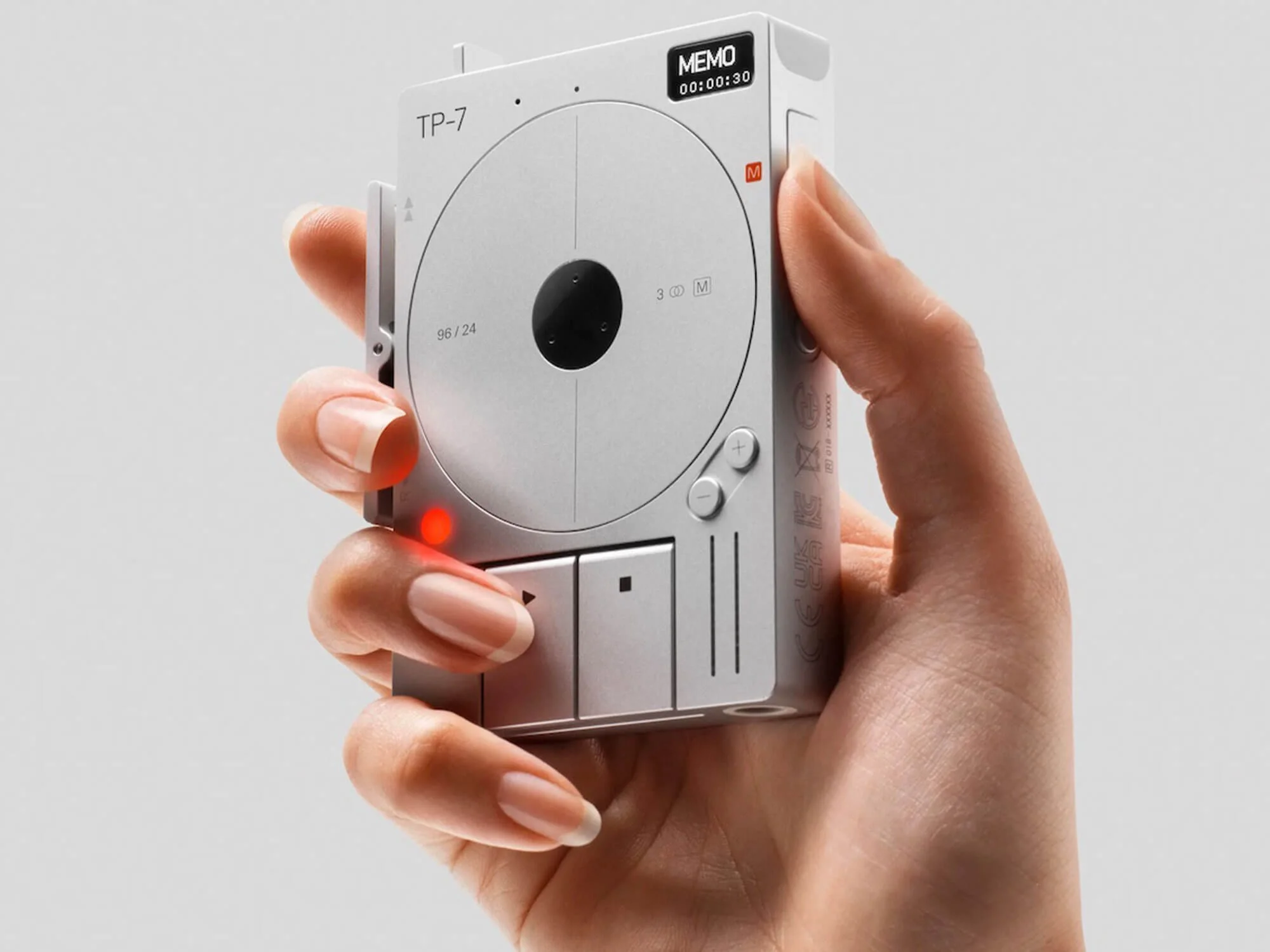
The Teenage Engineering TP-7 sits slightly outside the usual field-recording conversation, and that’s exactly why it’s interesting. Instead of chasing specs, it focuses on immediacy and tactility: a slim, pocketable form factor, internal storage, a built-in rechargeable battery, and a physical dial that makes recording feel almost like using a notepad. It’s the kind of device you keep with you by default, which often leads to more recordings simply because it lowers the mental barrier to pressing record.
From a pure field-recording perspective, the TP-7 isn’t trying to compete with pro rigs or even traditional handhelds. The onboard mic is fine rather than exceptional, and it’s not built around external mic workflows. But as a creative tool — for capturing ideas, voices, incidental sounds, or moments you’d otherwise miss — it makes a lot of sense. If your goal is to record often rather than perfectly, and you’re drawn to tools that feel more like personal objects than audio gear, this is a compelling alternative to spec-driven recorders.
Check price
Using your phone – the overlooked (and sometimes perfect) field recorder
It’s easy to dismiss phone recordings as a last resort, but there’s a reason iPhone audio keeps showing up in music, videos, and sound design projects. The built-in mic has a distinctly mid-forward, slightly compressed, almost lo-fi character that can be surprisingly pleasing, especially for found sounds, voices, mechanical noise, and everyday ambiences. It doesn’t try to sound “hi-fi,” and that honesty often makes recordings sit well in a mix without much work. For spontaneous capture, it’s also the one recorder you already carry, which means it often beats dedicated gear simply by being there at the right moment.
Where phone recording really opens up is with a few essential accessories. A small clip-on lav mic or compact stereo mic can dramatically improve clarity while keeping things pocketable, and a basic windscreen goes a long way outdoors. Using a dedicated recording app gives you better control over format and gain, and a lightweight grip or mini tripod helps reduce handling noise. You won’t replace a proper field recorder for serious ambience work, but as a creative tool — especially when you lean into its character rather than fight it — your phone can be a genuinely useful part of a field recording setup.
So, which field recorder makes sense for you?
If you want to start recording sounds now, the smaller handheld options are the most important ones. A pocket recorder like the Zoom H1essential or Tascam DR-07XP removes friction and helps you build the habit of listening and capturing, which matters far more than pristine specs early on. Once you feel the limits of onboard mics, stepping up to something like the Zoom H4essential or Portacapture X6 gives you room to grow without forcing you into a fully “pro” mindset.
From there, the split becomes philosophical rather than technical. Recorders like the Zoom F3 and Sound Devices MixPre-3 II are about committing to sound quality, microphone choice, and intentional recording sessions. The Teenage Engineering TP-7 sits outside that ladder entirely, reminding you that creativity often comes from tools you enjoy using. In the end, the best field recorder isn’t the one with the longest spec sheet — it’s the one you’ll actually carry, turn on, and use to turn the real world into your own raw material.
Disclosure: This site contains affiliate links. If you purchase through these links, I may earn a commission at no extra cost to you.